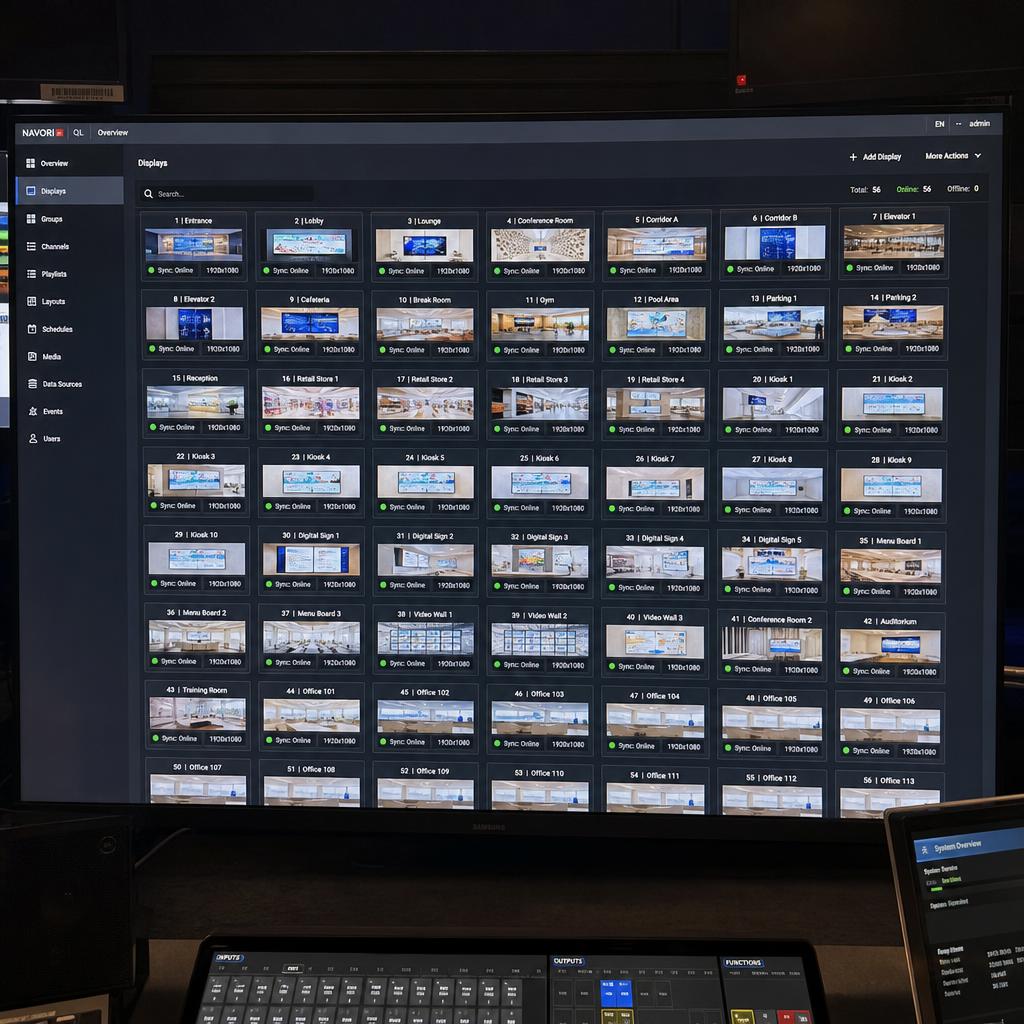
The maximum number of displays that can be kept in sync isn't governed by a single number — it depends heavily on the synchronisation approach, the network the players share, and how demanding the content is.
Factors That Determine Scale
Synchronisation Method
- Hardware genlock: Physically wired systems are typically limited by cable runs and distribution amplifier capacity — practical for tens of displays within a single venue, not distributed networks.
- Software-based sync (NTP/PTP over IP): Because coordination happens over standard networking, this approach scales far beyond what physical genlock cabling allows, including across separate buildings, cities, or countries.
Network Conditions
- Local network sync: On a single well-managed local network, hundreds of displays can be tightly synchronised with minimal drift.
- Wide-area/distributed sync: Across the public internet, latency and jitter between locations are higher and more variable, so achievable precision is typically measured in tens of milliseconds rather than frame-accurate microseconds — still enough for coordinated messaging, though not always tight enough for a single seamless video image spanning locations.
Content Complexity
- Simple synchronised triggers (all screens change to the next slide together) are far less demanding than frame-accurate video sync across a large video wall, so the same infrastructure can support many more displays doing the former than the latter.
Practical Ranges
- Single video wall (frame-accurate): Typically dozens of displays driven by a handful of coordinated computers/nodes, limited more by rendering and controller capacity than sync precision itself.
- Single venue, coordinated but not frame-locked: Hundreds of displays (e.g., a stadium's ribbon boards and concourse screens) can be synchronised for coordinated content changes.
- Multi-site network, coordinated messaging: Thousands of displays across many locations can be kept in sync for scheduled content changes, emergency overrides, and coordinated campaigns, since this doesn't require frame-level precision.
Where the Real Limits Show Up
In practice, the binding constraint is rarely "how many displays can technically receive a sync signal" — it's whether the required precision (frame-accurate vs. coordinated-within-seconds) matches what the network and method can deliver at that scale. Frame-accurate video wall sync scales differently than "all screens switch content at 9:00am."
SPARC's Scalability
SPARC's software-based synchronisation engine is designed to scale from a single video wall to global networks of thousands of players. Frame-accurate sync is best suited to co-located video walls, while the same underlying WebSocket architecture coordinates content changes, emergency overrides, and scheduling across distributed installations worldwide.