Government Digital Signage That Reaches Every Citizen
Local councils, state agencies, and public sector organisations use SPARC's government digital signage solutions to manage citizen-facing displays, queue systems, public safety alerts, and multi-language communications — with the accessibility compliance, security architecture, and audit controls that government procurement requires.

The Government & Public Sector Digital Signage Challenge
Common pain points that hold government & public sector back from delivering their full potential.
Public safety and emergency alerts can't reach everyone who needs them in time
A severe weather event. A public health notice. A critical infrastructure alert. Government has a legal and moral obligation to reach every citizen in its facilities and public spaces — but email, PA systems, and static signage fail a significant portion of the people who need the information. Screens across service centres, transport hubs, parks, and community facilities that can be overridden instantly provide the coverage that legacy systems cannot.
Diverse communities need information in their language, not just English
In many Australian councils, 30 to 40 percent of residents speak a language other than English at home. Government facilities that communicate only in English are failing a substantial portion of the community they're funded to serve. Managing translations across every display at every location sounds complex — but with the right platform, language rotation can be configured once and run automatically without any ongoing manual effort.
Citizen service centres have long wait times and poor queue experience
Citizens wait 45 minutes to renew a licence or resolve a rates query. With nothing to do but watch the queue progress, the wait feels longer than it is. Queue management displays that show estimated wait times, call numbers, and direct citizens to the right counter transform the experience — not by making the queue shorter, but by making it navigable and transparent, which research consistently shows increases satisfaction.
Accessibility compliance requirements create complexity for every display
Government facilities operate under accessibility obligations that require screen reader compatibility, appropriate contrast ratios, text sizing, and support for users with visual or hearing impairments. Managing these requirements across a fragmented mix of legacy signage systems — each with different capabilities and none centrally auditable — is a recurring compliance burden that compounds with every new facility.
Community facilities run content that's weeks or months out of date
The community centre screen still shows the summer programme schedule in September. The library display is promoting a book club that ended two months ago. The council park noticeboard shows an event from last year. No one person is responsible for maintaining these screens, the content was loaded once and forgotten, and there's no system for keeping it current. Content that's visibly outdated damages trust in government communications generally.
Security and procurement requirements slow down or block technology adoption
Government technology procurement requires demonstrable security architecture, data sovereignty commitments, encryption standards, and compliance documentation. Many digital signage vendors can't provide what procurement teams need — so the process stalls, an exemption is filed for the existing system, and the community continues with signage that doesn't serve them. A platform built with government security requirements in mind accelerates rather than obstructs procurement.
How SPARC Runs Government & Public Sector Digital Signage
Purpose-built capabilities for government & public sector.
Public Safety and Emergency Broadcast
Override every screen across every facility within seconds of triggering an alert — no manual steps at each location. Pre-configure templates for natural disasters, public health emergencies, evacuation procedures, missing persons alerts, and all-clear notifications. Integrate with existing mass notification systems or operate SPARC as a standalone visual alert layer. Every citizen in every building sees the message simultaneously.
Queue Management and Service Centre Displays
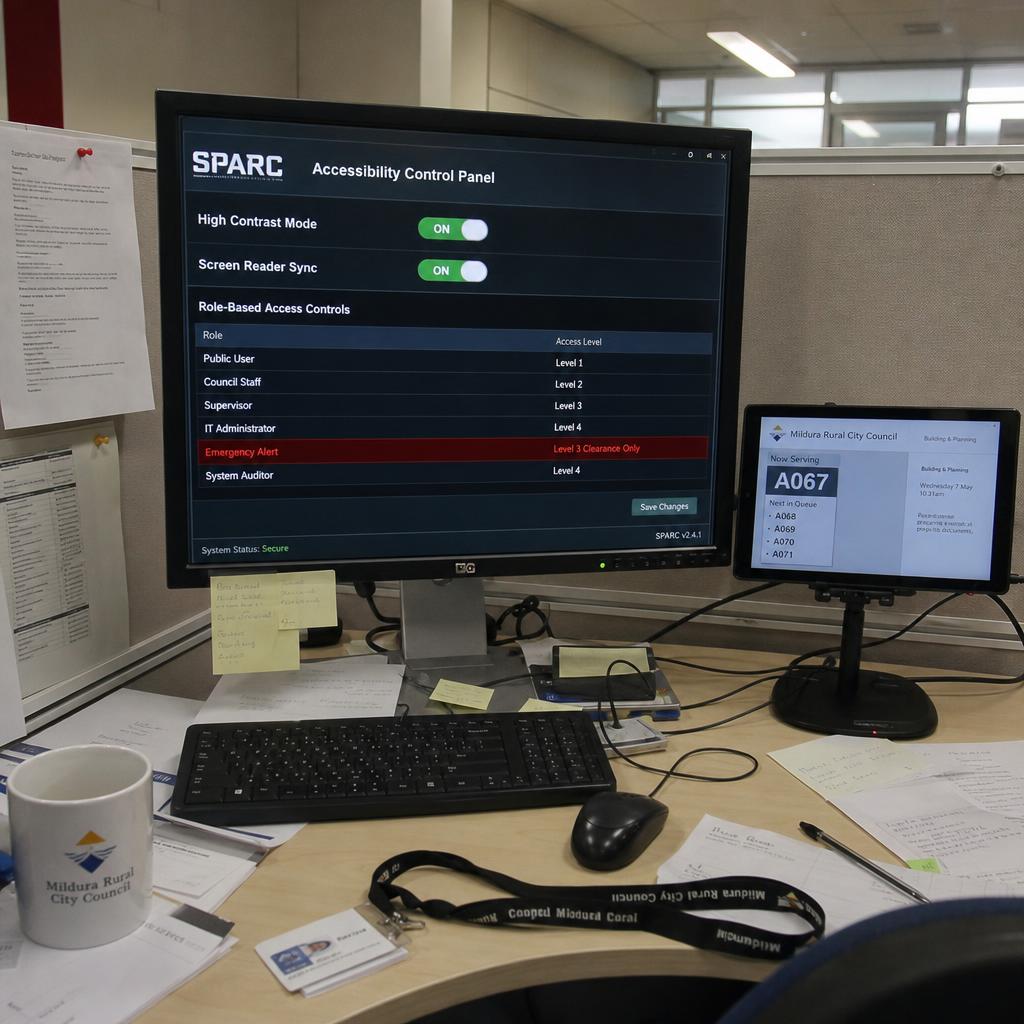
Display queue numbers, estimated wait times, counter assignments, and service directions on screens throughout service centres, motor registries, and public counters. Reduce perceived wait time and redirect citizens to the correct service point before they reach the front of the wrong queue. Integrate with your existing queue management system or use SPARC's built-in queue display capabilities as a standalone solution.
Multi-Language Content Automation
Configure language rotation rules for each display location and let the system handle delivery. A service centre in a high-CALD-population area rotates through the top five languages spoken in that catchment automatically. Safety information appears in every configured language within the same display cycle. Set the rules once — no manual publishing required for each language variant. Content equity without operational complexity.
Accessibility-First Display Standards
SPARC templates are built to WCAG accessibility standards with configurable contrast ratios, minimum text sizes, and layout structures designed for viewers with low vision. Screen reader metadata support, hearing-loop integration for audio-equivalent content, and content review workflows that flag accessibility issues before publishing. Meet your obligations without making accessibility a separate compliance project.
Community Facility and Event Information
Manage content across every library, community centre, recreation facility, park, and public space from a central dashboard. Each facility can manage its own local programming — class schedules, event calendars, community announcements — while council-wide communications can be pushed to all locations simultaneously. Content expires automatically so no screen is ever promoting something that already happened.
Secure Government-Grade Infrastructure
SPARC's architecture supports Australian data sovereignty requirements, with encryption in transit and at rest, role-based access controls, comprehensive audit logging, and multi-factor authentication. Security documentation suitable for government procurement review is available on request. Content permissions are granular — an operator at a single service centre can only publish to their own screens, not to any other facility.
Transport and Wayfinding Displays
Guide citizens through large government facilities, multi-level service centres, and public spaces with directory signage systems and dynamic directional displays. Update wayfinding in real time when a counter closes, a service area relocates, or a new temporary service point opens. Display real-time public transport information alongside government service information to help citizens plan their visit end-to-end.
Centralised Content Control with Delegated Local Publishing
Communications teams control brand standards and approve templates. Local facility managers publish within those guardrails without needing central approval for routine updates. State-level or agency-wide communications override local content when required. The hierarchy mirrors how government actually operates — central policy, local delivery — with audit trails that show who published what and when.
Government & Public Sector Digital Signage Outcomes
Public safety alert delivery time to every screen across every government facility from a single triggered broadcast
Language rotation rules set once per location — safety and service information delivered automatically in every configured language
Content audit visibility — every screen, every location, every published item tracked with a timestamped log for compliance reporting
Government & Public Sector Digital Signage Use Cases
Government digital signage FAQs
Can SPARC broadcast emergency alerts across all facilities at once?
Yes. An authorised operator can override every screen across every connected facility within seconds of triggering an alert, with pre-configured templates for evacuation, severe weather, public health, and all-clear notifications. SPARC can integrate with existing mass notification systems or run as a standalone visual alert layer.
Does SPARC support multi-language content for diverse communities?
Yes. Language rotation rules are configured once per location — a service centre in a high-CALD-population area rotates automatically through its top spoken languages, with no manual publishing required for each variant.
Is SPARC suitable for government security and procurement requirements?
SPARC's architecture supports Australian data sovereignty, encryption in transit and at rest, role-based access controls, comprehensive audit logging, and multi-factor authentication. Security documentation for procurement review is available on request.
Can SPARC meet accessibility compliance requirements for public displays?
SPARC templates are built to WCAG standards with configurable contrast ratios, minimum text sizes, and screen-reader metadata support, with content review workflows that flag accessibility issues before publishing.
Can councils install digital signage themselves?
Screens in public buildings generally need licensed electrical work, accessible mounting heights and compliant fixings, so installation goes through our partners or your existing panel of contractors. Content is then managed in-house by your communications team.
Who controls what appears on public-facing screens?
Your communications team, with approval rules you define. Someone drafts, someone approves, and only then does it reach a screen - which matters when the content is public information and accuracy is a statutory obligation.
How long does a council rollout take?
Software configuration is measured in days. Physical installation follows procurement and contractor availability, so budget on weeks per site. Emergency and public notice capability is available from the first screen going live.
Do councils need technical staff to run digital signage?
No. Communications staff publish without IT involvement. IT is consulted once, to set network access and who can publish where, and then the system runs itself.
Is public information signage the same as digital signage?
Yes. The distinction for government is governance rather than technology: audit trails of what was displayed and when, approval workflows before publication, accessibility requirements, and data held in Australia.
Where is government digital signage data hosted?
In Australia, on AWS Sydney, consistent with the Australian Privacy Principles - which is usually the first question a council procurement process asks.
Digital Signage for Other Industries
SPARC powers digital signage across dozens of environments. See how it applies elsewhere.



Ready to run government & public sector digital signage?
See how SPARC delivers measurable results for government & public sector.