
The Short Answer
Digital signage cost in Australia breaks into five parts. Two are paid once, and three keep costing you for as long as the screens are running.
- Screens — one-off. Advertised commercial displays run from about $500 for a 22-inch panel to about $3,450 for a 75-inch, with 100-inch panels near $6,000.
- Media players — one-off, and often nothing at all, because many commercial displays have a player built in. A separate Android player can cost as little as $160; an industrial slot-in player is closer to $800.
- Software — recurring. Self-serve platforms advertise from USD $8 to $10 per screen per month. Enterprise platforms usually quote by deployment.
- Installation — one-off, quoted per site, and driven more by walls, power, data and access than by screen size.
- Content — recurring, and usually paid in staff time rather than as a line item.
Every price in this guide is an advertised price on an Australian retailer listing in September 2026. Prices move constantly and none of them include installation, so treat them as a starting point for a budget rather than a quote.
Screens: The Biggest One-Off Cost
Screen size drives most of the hardware budget. These ranges come from advertised commercial display listings:
- 22–24 inch: about $500–$600. An LG 22SM3G-B listed at $498.95 and a Samsung QB24C at $598.99. Suits counter tops, meeting room doors and small menu panels.
- 43 inch: about $680–$1,200. A Samsung QB43C-N from $679 and 43-inch Android commercial displays around $1,195.
- 50–55 inch: about $1,150–$1,700. A Philips Q-Line 50-inch at $1,148.99 and 55-inch commercial displays from $1,235 to $1,690. The most common size for menu boards and corridor screens.
- 65 inch: about $1,800–$2,500.
- 75 inch: about $3,450.
- 100 inch: about $6,000. A Hisense 100-inch panel rated for 24/7 use listed at $5,998.99.
- Outdoor, 43–55 inch: about $4,400–$7,700. High-brightness weatherproof displays cost several times more than indoor panels of the same size.
- LED signs: from about $9,900. Small LED signs were advertised between $9,900 and $13,870. LED video walls are quoted per project.
Commercial display or a normal TV?
A 55-inch consumer TV can cost well under half the price of a commercial panel, and for a screen that runs a couple of hours a day in a back office, that's often fine. The gap shows up in three places.
Operating hours. Commercial panels are rated for long daily use, but check the rating: some are rated 18/7 rather than 24/7. The Philips Q-Line above is an 18/7 panel.
Brightness. Screens near shopfront windows or in bright atriums need far more brightness than a living-room TV provides.
Warranty. Consumer TV warranties often exclude commercial use, so a failure in a café or office may not be covered.
For a screen running all day in a shopfront, the cheaper TV frequently ends up costing more.
Media Players: Often Built In
A media player is the device that actually plays the content. Many commercial displays now have one built into the screen — Samsung SMART Signage and LG webOS displays are the common examples — so if your software supports that platform, you don't need a separate device at all.
Where a separate player is needed, advertised options include:
- Android media sticks from about $160, such as an OptiSigns Android stick listed at $160.
- Industrial OPS players around $800, such as an Advantech DS-280 slot-in player at $798.50.
- An existing Windows PC or Chrome OS device, which costs nothing extra if it's already on site.
Choose a player based on what your software supports well, not on price. A cheap player that drops offline every few days costs more in site visits than it saved. SPARC's supported hardware covers Android, Windows, Amazon Fire and browser-based players.
Software: The Cost That Compounds
Digital signage software is usually charged per screen, per month. As of September 2026, Yodeck advertised a basic plan at USD $8 per screen per month, and OptiSigns advertised USD $10 per screen per month. Enterprise platforms more often quote per deployment based on screen count and features.
Two things decide what software really costs.
The currency. A price in US dollars means your Australian cost moves with the exchange rate every month. For a large network, that variability becomes a budget line your finance team will notice.
What's included. Check whether content management, user seats, scheduling, analytics, support and extra modules are in the base price or charged separately.
Software is also the cost that grows with your network. Fifty screens at USD $10 a month comes to USD $18,000 over three years, before any add-ons. At that scale, software outweighs the screens. Compare platforms on three-year cost at the screen count you actually plan to reach, not on the month-one price. Our comparison of digital signage CMS platforms in Australia covers what separates the options.
Installation: Why Quotes Vary So Much
Installation is the hardest cost to estimate from a distance, because it depends on the building rather than the screen. These are the things that move a quote:
- Wall construction. Plasterboard needs different fixings to brick or concrete, and heavy screens or video walls may need structural backing.
- Power. New power points have to be installed by a licensed electrician. In Australia that's a legal requirement, not a preference.
- Data. A wired network connection is more reliable for signage than Wi-Fi, but adds cabling.
- Height and access. Ceiling-hung screens, atriums, and after-hours work in a venue that's open during the day all add labour.
- Video walls. Multiple panels need precise alignment and colour calibration.
- Outdoor screens. Structural mounting and weatherproofing add cost, and signage visible from a road may need council approval depending on its size and location.
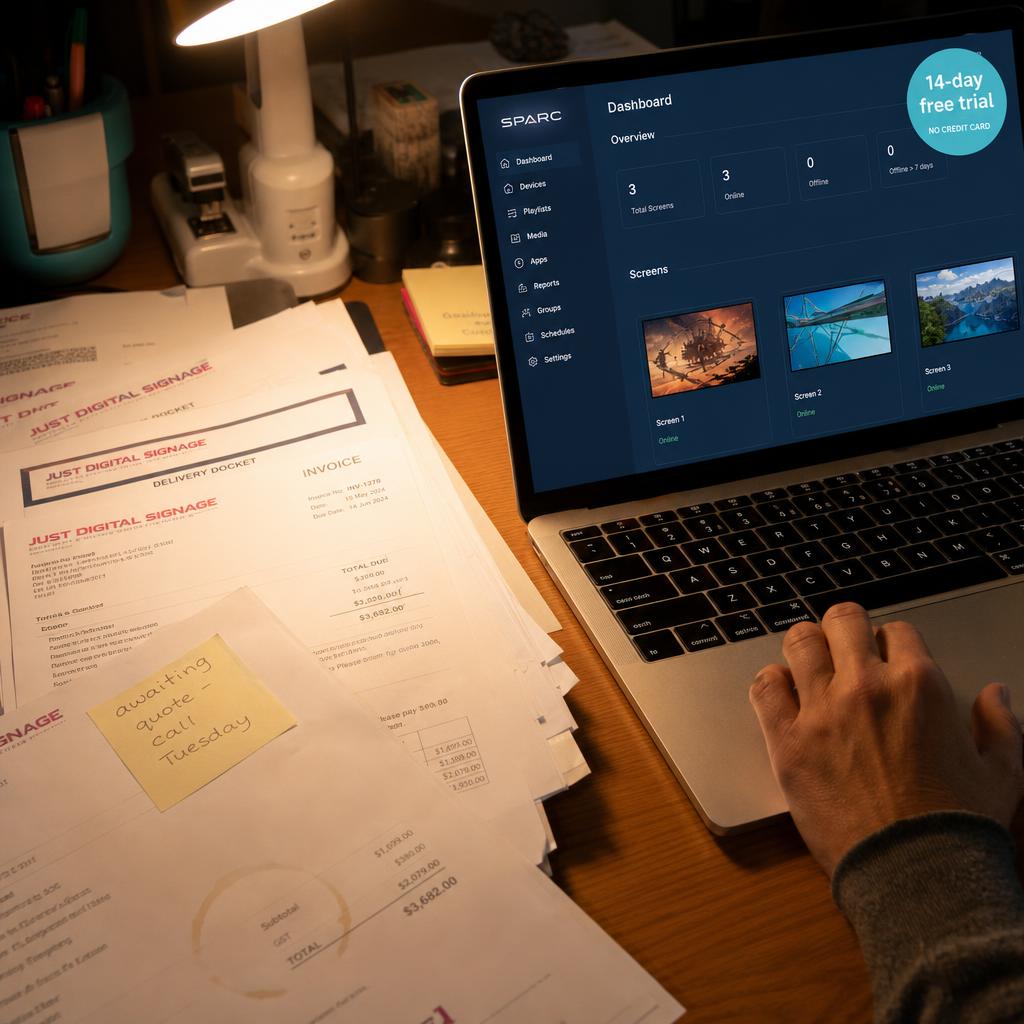
Ask for quotes that itemise supply, installation, software and content separately. Bundled quotes are hard to compare and easy to overpay on.
Content: The Cost Nobody Budgets For
Content is where most signage budgets quietly overrun, because it rarely appears as a line item. Someone has to design the slides, update prices, swap in the weekend promotion and take down last month's campaign.
Templates keep that time low for everyday updates, while a design agency makes sense for launches and brand campaigns. The bigger saving is scheduling: content that changes itself by time of day, day of week or date doesn't need anyone to remember to change it. Our look at the real cost of manual content scheduling puts numbers on that hidden time.
A Worked Example: Three Screens in a Café
Here's how the parts add up for a small venue running three 55-inch menu screens, using the advertised prices above:
- Screens: 3 × 55-inch commercial displays at $1,235–$1,690 = $3,705–$5,070
- Players: $0 if the displays have a built-in player your software supports, otherwise about 3 × $160 = $480
- Software: 3 screens at entry-level self-serve pricing of USD $8–$10 each per month = about USD $290–$360 a year
- Installation: quoted per site
- Content: a few hours to set up templates, then minutes a week with scheduling
That's roughly $3,700–$5,550 up front before installation, plus a few hundred US dollars a year in software. A chain running the same setup across twenty venues multiplies the software cost by twenty — which is exactly when currency, multi-site management and support start to matter more than the entry price.
Where You Can Spend Less
- Reuse commercial displays you already own, where they're bright enough for the space and your software supports them.
- Buy displays with a built-in player to avoid separate hardware and one more thing to fail.
- Pilot before you roll out. Run a few screens for a month before committing to a network.
- Don't specify LED where an LCD panel will do. LED earns its cost on very large or very bright installations, not on a menu board.
- Compare software over three years, at your planned screen count, in Australian dollars.
How SPARC Is Priced
SPARC quotes in Australian dollars based on your screen count, so there's no exchange-rate exposure, and content management is included in every plan rather than licensed separately. Every plan starts with a 14-day free trial.
SPARC is hardware-agnostic, so it can run on commercial displays you already own instead of requiring new screens. For a quote based on your deployment, see SPARC pricing.
Frequently Asked Questions
How much does digital signage cost per month?
The monthly cost is mostly software, charged per screen. As of September 2026, self-serve platforms such as Yodeck and OptiSigns advertised from USD $8 to $10 per screen per month, while enterprise platforms usually quote by deployment. Screens, players and installation are one-off costs.
Can I use a normal TV for digital signage?
For a screen that runs a few hours a day indoors, often yes. For all-day operation, bright spaces or customer-facing use, a commercial display is usually the better buy: it's rated for longer daily use, it's brighter, and consumer TV warranties often exclude commercial use.
Do I need a separate media player?
Not if your commercial display has a built-in player your software supports, such as Samsung SMART Signage or LG webOS. Otherwise, advertised players range from about $160 for an Android stick to around $800 for an industrial slot-in player.
How much does a video wall cost?
Video walls vary too widely for a single figure. The cost depends on panel type, size, mounting, calibration and whether it's LCD or LED, so they're quoted per project. Small single LED signs were advertised from about $9,900 in September 2026.
Why do digital signage quotes vary so much?
Mostly installation scope and bundling. Wall construction, new power, cabling, access and outdoor work change the labour involved, and some quotes bundle software and content while others don't. Ask for supply, installation, software and content to be itemised separately.