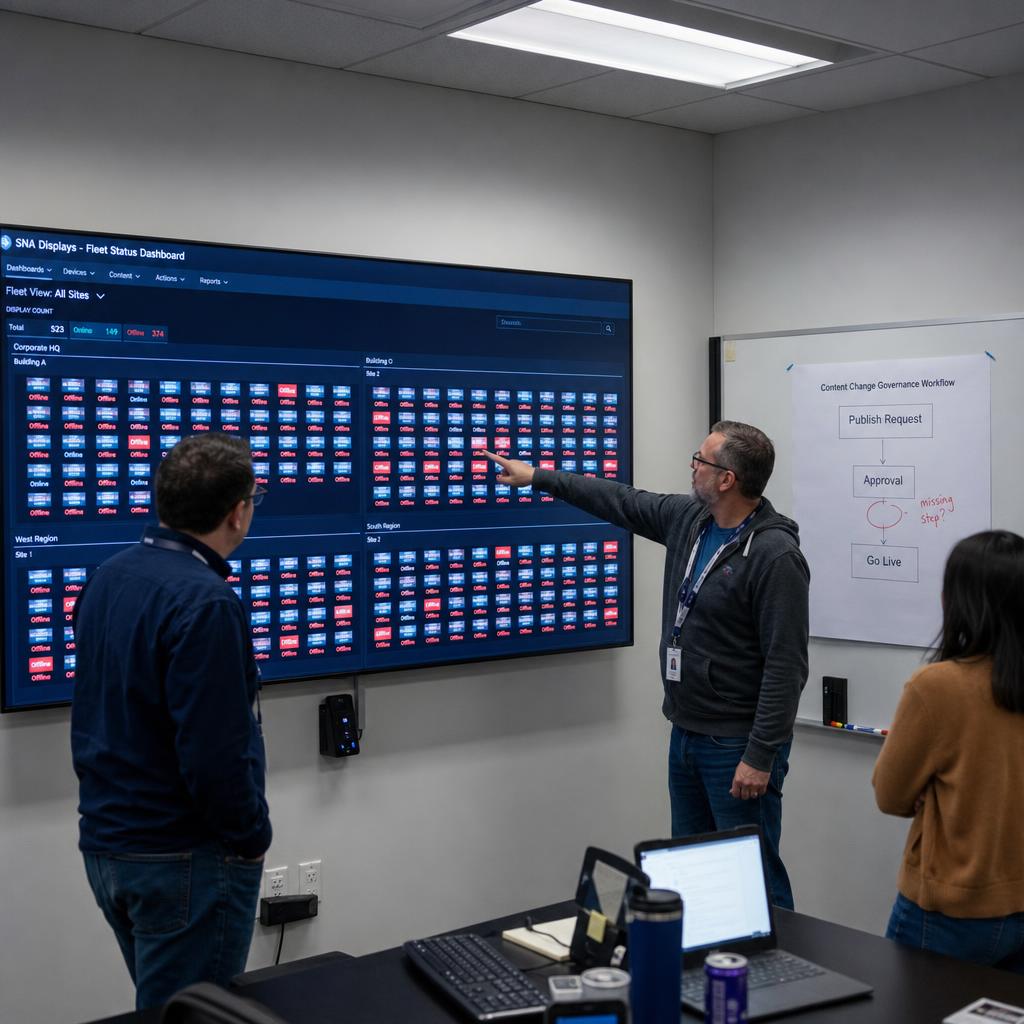
Why Doesn't a Successful Pilot Predict a Successful Rollout?
Because the pilot relied on manual effort and informal judgement calls that do not survive contact with hundreds of screens.
Five screens can be managed by one person checking a dashboard each morning. Five hundred across dozens of sites need a system that does not depend on that person's memory or availability.
The pattern is consistent:
- A single administrator sets up the pilot with full access
- Content gets uploaded ad hoc rather than through a defined approval step
- Screens get named "Foyer TV", because everyone remembers which is which
None of those are wrong decisions for a pilot. The failure comes from treating the pilot's operating model as proven at scale, when it was only validated for the conditions it was tested under.
What Is Governance Debt, and When Does It Bite?
Governance debt behaves like technical debt: invisible while the network is small, expensive to unwind once it is not.
With no defined publishing workflow, whoever has access pushes content live. As the network grows, more people need publishing rights, and without a structured permission model access gets granted broadly and revoked rarely.
It shows up as specific incidents:
- A promotional price still displaying after the promotion ended, because nobody owned taking it down
- A former staff member's login still holding publishing rights months after they left
- Two sites running contradictory versions of the same campaign
We have covered how to build governance structure properly in structuring governance before you scale. This post is deliberately about what happens when that step gets skipped.
How Does Hardware Fragmentation Happen?
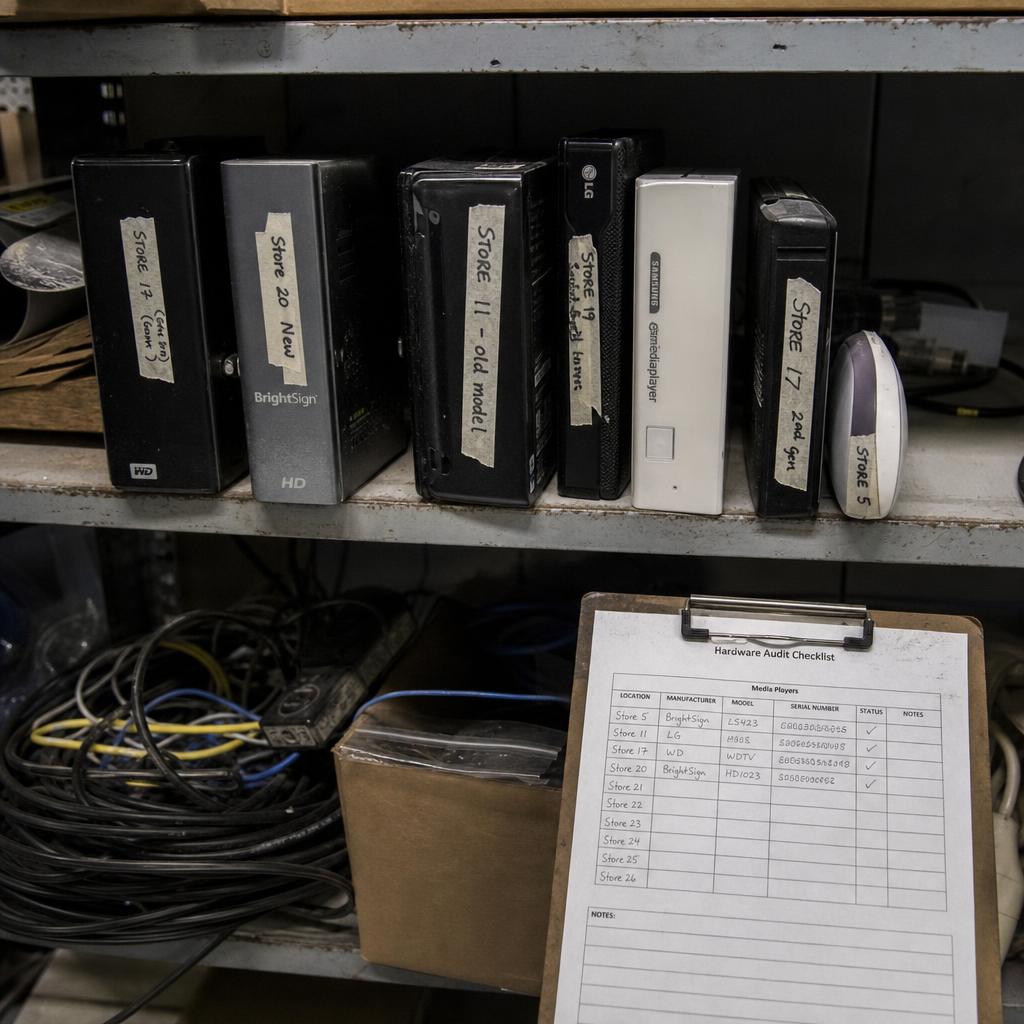
Never on purpose. It happens because signage hardware gets bought in small batches, by different people, over a long enough period that "whatever we bought last time" stops being available.
A pilot runs on one media player model. Eighteen months later the network has three player generations and at least one site where a manager bought whatever was on the shelf locally.
The operational cost is real:
- Firmware updates that work on one device generation behave differently on another
- Support tickets stop being simple diagnoses and start being investigations
- Content that renders correctly on one player looks wrong on another
The practical response is not ripping everything out. It is setting a hardware standard going forward and converging toward a smaller set of supported configurations as devices are replaced anyway.
When Nobody Owns Monitoring, Everyone Assumes Someone Does
At pilot scale, monitoring is implicit — someone walks past the screen. That informal model doesn't scale, but because nobody explicitly decided to stop monitoring, the gap isn't obvious until a screen has been blank for days.
This is less a technology failure than an ownership failure. Marketing assumes IT is watching the network; IT assumes site staff will report problems; site staff assume head office would tell them if something needed attention. Fixing this requires a decision: who gets the alert, what they're expected to do with it, and what the acceptable response time is.
Vendor Lock-In You Don't Discover Until It's Expensive
Lock-in rarely announces itself during the sales process. It shows up later, when the organisation tries to export historical content and proof-of-play data to a new system, or negotiate contract renewal terms from a position where switching is realistically an option.
The mechanisms are usually mundane: content stored in a proprietary format that doesn't export cleanly, hardware that only works with that vendor's software. The practical safeguard is checking export and interoperability terms before signing, not after a renewal negotiation makes it relevant — reasonable questions to ask any vendor at evaluation stage, including of SPARC's enterprise plans.
Common Failure Patterns: Symptom, Root Cause, What Actually Fixes It
| Symptom | Root cause | What actually fixes it |
|---|---|---|
| Screens go blank and nobody notices for days | No assigned owner for monitoring alerts | Assign uptime monitoring ownership explicitly, with a defined response SLA |
| Content is inconsistent or outdated across sites | No content approval workflow; publishing rights too broad | Role-based permissions and a defined publish/approval step |
| Rollout stalls after the first 10-20 sites | Pilot processes were manual and don't scale | Rebuild the operating process for scale before adding more sites |
| IT is flooded with device-specific support tickets | Hardware fragmentation across sites | A documented hardware standard for new and replacement purchases |
| Contract renewal negotiations feel one-sided | Vendor lock-in via proprietary formats | Confirm export and interoperability terms before signing |
| A former employee still has publishing access | No offboarding step tied to signage permissions | Access reviews tied to HR offboarding |
Which Failure Pattern Fits Your Organisation
Still at pilot stage, under 20 screens. The priority is not fixing failures yet. It is not mistaking pilot success for scale-readiness.
Mid-rollout, 20 to 100 screens. This is where governance debt and hardware fragmentation first become visible. Pause expansion briefly and formalise the processes.
Already at scale and firefighting, 100+ screens. Fix the highest-cost gap first, which is usually monitoring ownership — undetected downtime is the most visible and expensive failure.
Evaluating a new platform because a previous rollout failed. Be specific about which pattern caused it. If franchisees or licensees were involved, see franchise rollout governance for the added complications.
What connects all four: none of these failures are caused by the screens. They are caused by governance, monitoring and hardware decisions made when the network was small enough that none of them seemed to matter.
If you are at the 20-to-100 screen point and starting to feel the friction, that is the cheapest moment to fix it. Book a demo and we will go through where your governance and monitoring gaps actually are, before they become the reason for a re-platform.
Digital signage at scale: FAQs
What's the single biggest reason digital signage systems fail at scale?
The most common pattern is a governance and process gap rather than a technology gap — the manual, informally-owned processes that worked fine at pilot size don't hold up once the network passes roughly 50-100 screens across multiple sites or teams.
How many screens is too many for a manual, informal process to keep working?
There's no fixed number, but organisations commonly start feeling the strain between 20 and 50 screens, particularly once more than one person needs publishing access.
Is vendor lock-in avoidable, or is it just a cost of doing enterprise signage?
It's largely avoidable if checked at evaluation stage rather than discovered at renewal. Ask any vendor directly about content export formats and hardware dependency before signing.
We're already past 100 screens and seeing these problems. Do we need to start over?
No — retrofitting governance, monitoring ownership, and a hardware standard onto a live network is more common than building it upfront, and achievable without a full rebuild.
Whose job should signage monitoring actually be?
It needs to be someone's explicit job, with a defined response time, rather than an assumed responsibility — usually IT or a facilities/operations team, with a clear escalation path.
Does franchise or multi-operator signage fail for the same reasons as a single corporate network?
The same root causes apply, but they're sharper in franchise networks because publishing control is split across parties who don't report to the same management chain.
Ready to Experience SPARC?
Join forward-thinking organizations already using SPARC for their digital signage needs.