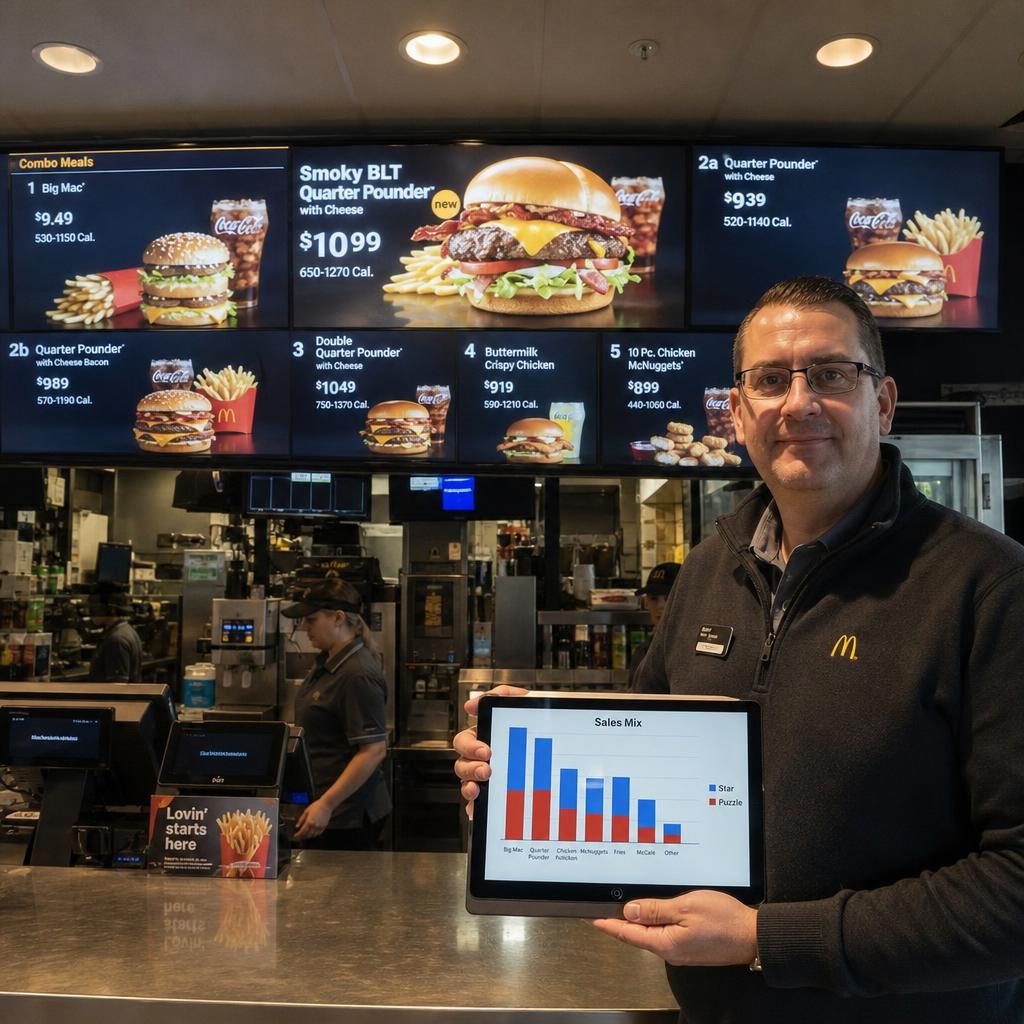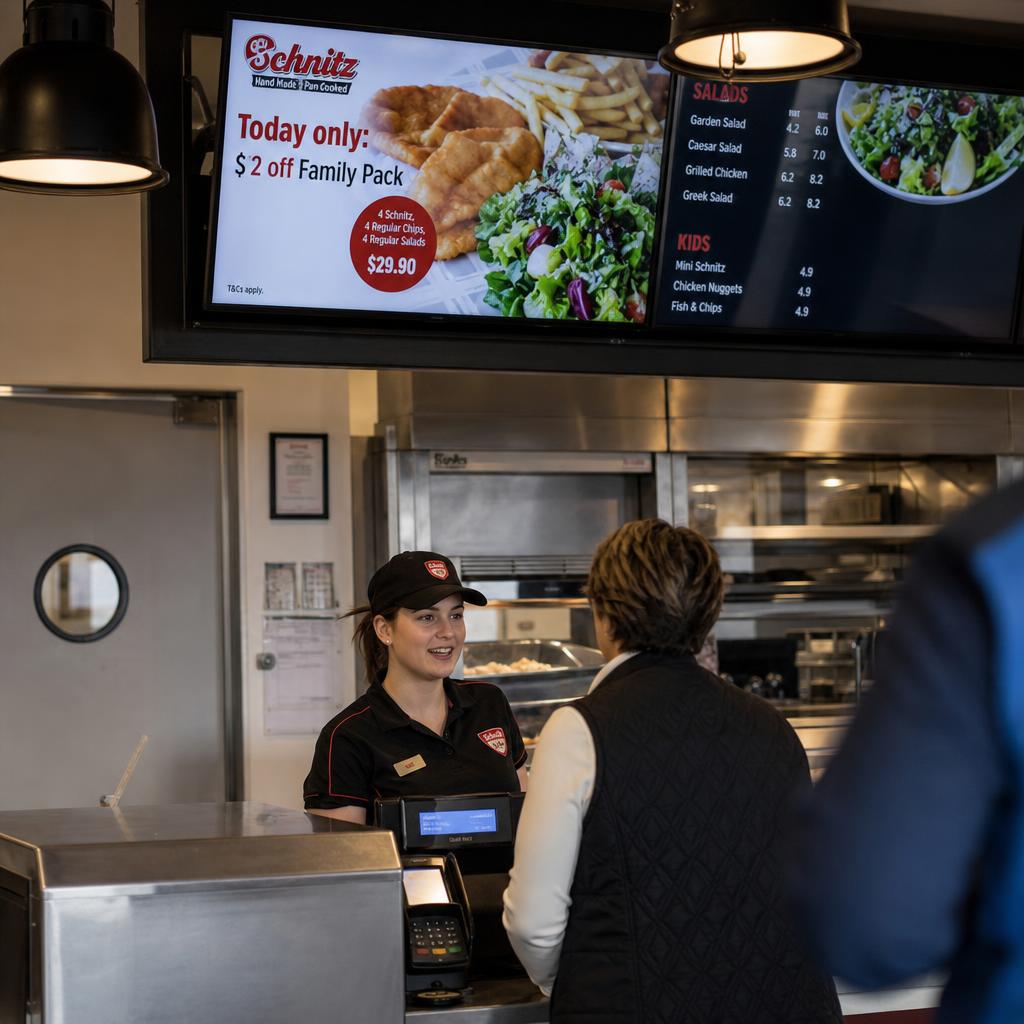
Franchise digital signage governance is the set of rules, templates and approval workflows a franchisor uses to keep screens on-brand across independently owned locations — while still letting franchisees update local details like hours, pricing and promotions.
It matters because a franchisor does not control every location the way a corporate retailer controls its own stores. Franchisees own the premises, the P&L and often a strong opinion about what their screen should say.
Get the model wrong and you get one of two outcomes:
- A rigid system franchisees route around
- A free-for-all that erodes the brand one screen at a time
This is a different problem to managing a fleet of company-owned displays. It's also different to the cost case for replacing paper signage and printed menu boards. Franchise governance is specifically about who gets to decide what appears on a screen when the person paying for the location isn't the person who owns the brand.
Why Is Franchise Signage a Governance Problem?
In a corporate-owned network, a rollout is an operations and IT exercise: pick a platform, standardise the hardware, push content from head office, done.
Franchise networks add a layer that has nothing to do with technology: legal and commercial autonomy.
Franchisees have signed agreements granting operational control over their site. In most systems that includes a reasonable expectation of some say over what their customers see in store.
That means a franchise signage rollout has to solve two problems simultaneously. The first is the same as any multi-site network: getting consistent, functioning displays into every location. The second is uniquely franchise-shaped: designing a system where head office can protect the brand without having to personally approve every "10% off schnitzels this Thursday" message from every store.
Skip the second problem and one of two failure modes follows:
Franchisees feel shut out. They plug in their own laptops, print A-frame signs, or lobby the franchise council to loosen the rules.
Or head office locks it down too tightly. Local managers cannot respond to a stockout, a weather event or a genuinely useful local promotion, and the screens become as inflexible as the printed signage they replaced.
What Does Each Side Actually Care About?
Every franchise signage governance conversation eventually comes back to the same trade-off: how much local control is too much, and how much central control is too much?
Both sides care about a narrow set of things, and the sets barely overlap.
Franchisors care about:
- Logo usage, colour palette and typography
- Claims and disclaimers
- Pricing accuracy
- The look and feel that makes one location recognisably the same brand as another 500 kilometres away
Franchisees care about:
- Their trading hours being correct
- Their local promotion being visible
- The screen reflecting what is actually in stock that day
- Not waiting on a head-office approval queue to advertise a Tuesday special
Neither list is unreasonable. The governance model's job is to serve both without either side having to ask permission for what they legitimately own.
The mistake many networks make is treating this as a binary choice between "franchisor controls everything" and "franchisees control everything." In practice, workable governance separates content into layers, and applies a different level of control to each layer:
- Brand assets (logo, colours, fonts, menu photography, legal disclaimers) — locked, franchisor-controlled, never editable by franchisees.
- Layout and structure (where the price sits, how a promo banner is framed, screen sequencing) — franchisor-designed templates that franchisees populate but don't redesign.
- Local variable content (store hours, local phone number, a location-specific offer, weather-driven messaging) — franchisee-editable within defined fields.
- Franchisee-originated promotions (a local sponsorship, a community event, a store-specific deal) — franchisee-submitted, franchisor-approved before it goes live.
Framing governance this way turns an abstract fight over "control" into a concrete, defensible set of rules that both sides can actually point to.
Building a Digital Signage Template System
The template system is where most of the governance work actually happens, because it's what turns the layered model above into something a non-designer franchisee can use without breaking the brand.
A workable template system typically has three characteristics:
Locked structure, open fields. The franchisor designs the layout — where the hero image sits, how pricing is displayed, what the footer contains — and locks it. Franchisees interact only with defined, editable fields: a price, a date range, a headline, an image chosen from an approved library. They cannot move, resize or restyle elements, which removes the single biggest source of off-brand signage: well-intentioned local edits that look nothing like the brand guidelines.
A constrained content library, not a blank canvas. Rather than letting franchisees upload any image or write any headline, the strongest systems give them a pre-approved library of assets — seasonal campaign creative, category photography, offer templates — that they select from and lightly customise. This gives franchisees genuine choice and local relevance without opening the door to off-brand fonts, low-resolution phone photos, or messaging that hasn't been legally checked.
Rules that are enforced by the system, not by goodwill. If a franchisee shouldn't be able to change the brand colour of a promo banner, the template shouldn't offer that control in the first place. Governance that relies on franchisees remembering a PDF of brand guidelines fails as soon as the network grows past a handful of sites. Governance that's built into what the software physically allows scales far better.
This is the same principle that underpins broader enterprise display management — content, scheduling and hardware need to be managed as a system rather than location by location — but in a franchise context the templates also have to encode where the franchisor's authority ends and the franchisee's begins.
Approval Workflows for Franchisee-Generated Content
Templates handle routine, structured content well. They don't solve everything — franchisees will always have content that doesn't fit a locked field: a genuinely local sponsorship, a one-off community event, a promotion that needs custom wording. This is where an approval workflow earns its keep.
A functioning approval workflow generally needs:
- A clear scope. Franchisees should know exactly what does and doesn't need approval. Editing a pre-approved template field shouldn't require sign-off; submitting a custom asset or new claim should.
- A defined reviewer and turnaround expectation. Someone at head office (or a regional marketing lead in larger networks) owns approvals, and franchisees know roughly how long a review takes. Vague or unstaffed approval queues are what push franchisees back toward printed signs.
- Version and audit history. When something goes wrong — an incorrect price, an unapproved claim — the franchisor needs to see who submitted it, who approved it, and when it went live. This also protects franchisees: a documented approval trail shows they followed process.
- Escalation for time-sensitive content. A stockout notice or a weather closure can't sit in a 48-hour review queue. Build a fast-track path for genuinely urgent, low-risk content so franchisees aren't stuck waiting to communicate something operationally necessary.
Done well, an approval workflow feels like a light-touch check rather than a bottleneck. Done poorly, it becomes the reason franchisees quietly stop using the system — which is the same underlying failure mode explored in the cost of manual content scheduling for retailers, just triggered by governance friction instead of manual labour.

Choosing a Governance Model
Not every franchise network should govern signage the same way. The right model depends on brand sensitivity, franchisee experience, network size, and how much local market variation genuinely matters to the offer. Most networks land somewhere between two extremes, and it's worth being explicit about which model you're choosing rather than drifting into one by accident.
| Governance Model | Head Office Control | Franchisee Flexibility | Brand Risk | Best Suited To |
|---|---|---|---|---|
| Fully centralised | Head office creates and schedules all content; franchisees have no editing access | Minimal — franchisees may request changes but can't self-serve | Lowest | Highly regulated brands, new or inexperienced franchisees, small networks where head office can realistically manage volume |
| Hybrid (template-based) | Head office owns templates, brand assets and approval workflow | Moderate — franchisees populate approved fields and submit local content for review | Low to moderate, if templates and approvals are enforced | Most established multi-site franchise networks balancing consistency with local relevance |
| Franchisee-autonomous | Head office sets guidelines only; enforcement is largely manual | High — franchisees largely control their own screen content | Highest — depends entirely on franchisee compliance and goodwill | Very small networks, early-stage franchise systems, or brands with minimal design requirements |
Most networks that scale past a handful of locations converge on the hybrid model, because fully centralised control doesn't scale with head-office headcount, and franchisee-autonomous control doesn't scale with brand risk. The hybrid model is also the one that a template system and approval workflow, as described above, are specifically built to support.
A Phased Rollout Approach
There is no single fixed timeline for a franchise signage rollout, and franchisors should be sceptical of anyone who promises one.
Four things set the pace:
- The number of locations
- How varied the estate is — different store formats, different lease and power constraints
- How much internal resourcing the franchisor has for reviewing content
- How much change management the franchisee network needs
A ten-store network with an engaged franchisee council moves very differently to a two-hundred-store network spanning several states.
What does generalise across networks is the shape of the rollout, not the duration:
Start with a pilot group. Choose a small, representative sample of locations — ideally a mix of high-performing and average sites, and franchisees known to give direct feedback. The goal of the pilot isn't to prove the technology works; it's to stress-test the governance model. Are the template fields actually sufficient for what franchisees want to say locally? Is the approval turnaround realistic? Are there content types nobody anticipated?
Iterate on the governance rules, not just the hardware. Pilot feedback should change the templates, the approval scope, and possibly the governance model itself before wider rollout — not just fix technical bugs. This is the phase where a network discovers, for example, that franchisees need an editable secondary offer field, or that the approval queue needs a named owner rather than a shared inbox.
Scale in tranches, with support built in. Rolling out to the full network in one pass makes it hard to give each new franchisee proper onboarding and hard to catch governance gaps before they multiply. Staged rollout — by region, by franchisee group, or by store format — keeps support manageable and lets the franchisor keep refining templates as new edge cases appear.
Review governance periodically, not just at launch. Brand guidelines change, seasonal campaigns introduce new content types, and franchisee feedback keeps surfacing. Treat the template library and approval workflow as something that gets revisited, not something that's finished once the network is fully live.
Franchisors evaluating a digital signage platform for this kind of rollout should look specifically for template locking, role-based permissions and built-in approval workflows — capabilities that make the governance model enforceable rather than aspirational.
Common Governance Pitfalls
A few patterns show up repeatedly in franchise signage rollouts that struggle:
Treating brand guidelines as documentation instead of system rules. A PDF of brand standards doesn't stop a franchisee from resizing a logo if the software lets them. Governance that isn't built into the template system relies entirely on compliance, which doesn't hold at scale.
No clear owner for approvals. When approval responsibility sits with "marketing" in general rather than a named person or role, franchisee content queues stall, and franchisees lose confidence in the process.
Over-locking the system. The opposite failure is just as common — locking down every field so tightly that franchisees can't reflect anything local, which pushes them toward workarounds like separate printed signage or unauthorised screens.
Ignoring franchisee input during design. Templates designed entirely by head office marketing, without input from the franchisees who'll actually use them daily, tend to miss real operational needs — a seasonal menu swap field, a way to flag limited stock, a local phone number.
Assuming the pilot group represents the whole network. A pilot run only with your most cooperative, highest-performing franchisees will underestimate the governance friction that shows up once the system reaches less engaged or lower-resourced locations.
Measuring Governance Success
Franchise signage governance is working when a few things are true: franchisees are using the system rather than working around it with printed signage or unauthorised devices, brand audits find consistent execution of logo, colour and claims across locations, the approval queue moves fast enough that franchisees don't feel blocked, and support tickets related to "how do I change X" trend down over time rather than up.
It's worth tracking these deliberately rather than assuming governance is solved once the rollout is technically complete. A network that hits 100% hardware deployment but has 30% of franchisees quietly ignoring the approved template system hasn't actually solved the governance problem — it's just moved it out of sight.
Franchise digital signage FAQs
What is franchise digital signage governance?
It's the framework of rules, content templates and approval processes a franchisor uses to keep digital signage on-brand across independently owned franchise locations, while still allowing franchisees some ability to reflect local hours, pricing and promotions.
How much control should a franchisor have over franchisee screens?
Most established networks settle on a hybrid model: the franchisor locks brand assets and layout structure, franchisees edit defined local fields, and any franchisee-originated content goes through an approval step before going live. Full centralisation rarely scales, and full franchisee autonomy carries the highest brand risk.
Do all franchisees need to follow the same signage templates?
Generally yes, at the structural level — the layout, brand assets and legal disclaimers should be consistent across the network. What varies is the content within those templates: local hours, local offers and store-specific messaging, populated through editable fields rather than free-form design changes.
How long does a franchise digital signage rollout take?
There's no fixed timeframe that applies across all networks. It depends on the number of locations, how varied the store formats and infrastructure are, and how much internal resourcing is available to manage approvals and support. A staged rollout — pilot, iterate, then scale in tranches — tends to produce a more reliable outcome than targeting a fixed deadline.
What happens if a franchisee submits content that breaches brand guidelines?
In a hybrid governance model, franchisee-submitted content that falls outside pre-approved templates goes through a review step before publishing, so off-brand or non-compliant content is caught before it reaches a screen rather than after. Version and audit history also make it possible to trace what was submitted, by whom, and when.
Can franchisees add their own local promotions to digital signage?
Yes, in most workable governance models. Local promotions are usually handled as franchisee-submitted content that goes through an approval workflow, rather than being either fully blocked or published without review.
What's the difference between franchise signage governance and general fleet management?
Fleet management covers the operational mechanics of running many displays — content distribution, scheduling, device monitoring — typically across a network the operator owns and controls directly. Franchise governance adds a layer specific to divided ownership: deciding who has the authority to change what, and building templates and approval workflows that make that authority enforceable rather than just documented.
Franchise networks that get signage governance right don't do it by locking everything down or leaving it to goodwill — they build a template system and approval workflow that make the brand rules automatic, and roll it out in stages that leave room to fix what the pilot gets wrong. If you're planning a franchise signage rollout and want to see how a template-based governance model works in practice, book a demo with SPARC.