
Digital signage compliance in Australia is not governed by a single rulebook.
It sits at the intersection of accessibility guidelines, privacy principles, workplace safety obligations and advertising standards — which of those apply depends on what your screens display and where they are installed.
This guide covers the general areas worth knowing about. It is not legal advice, and what applies to your business should be confirmed with your own legal or compliance advisor. Treat it as a starting point for understanding the landscape, not a checklist to rely on unchecked.
Why Digital Signage Compliance Matters
Screens sit in public-facing spaces, usually displaying information a business is legally or practically expected to communicate clearly: pricing, safety information, wayfinding, promotions.
Getting it wrong is rarely a single dramatic breach. It is normally an accumulation of things nobody thought to check:
- Contrast too low for some viewers to read the screen
- A camera-based analytics feature nobody documented in a privacy policy
- Safety signage moved to a screen without confirming it still meets the obligations of the printed sign it replaced
Because signage spans several areas of law rather than one, compliance tends to fall between departments. Marketing owns the content, IT owns the platform, and nobody owns the question of whether the screens as a whole meet accessibility or privacy obligations.
Naming an owner for that question, even informally, is the single most useful step most businesses can take.
Five Digital Signage Compliance Areas to Check
- Accessibility — contrast, text size and colour
- Privacy — anything your signage collects about people
- Workplace safety — statutory signage obligations
- Advertising standards — accuracy of promotional content
- Data hosting and residency — where the platform stores your data
1. Accessibility: Contrast, Text Size and Colour
The Web Content Accessibility Guidelines are written for web content, but the underlying principles are widely regarded as good practice for any public-facing screen.
Whether formal WCAG conformance is a strict legal requirement depends on context — government and some public-facing digital services in Australia do have accessibility obligations under various frameworks — so this is genuinely a question for your advisor rather than something to assume either way.
The considerations most operators find useful regardless of formal obligation:
- Contrast that stays readable in the ambient lighting the screen is actually installed in, not the lighting it was designed in
- Font sizes appropriate to realistic viewing distance
- Never relying on colour alone, such as a red-only "closed" indicator with no accompanying text
- Not using fast-moving animation to convey essential information
These are sound design practices independent of any legal threshold, and they make signage more effective for every viewer.
2. Privacy: What Applies If Your Signage Collects Data
If your signage includes audience analytics of any kind — camera-based counting, Wi-Fi or Bluetooth detection, or any sensor that could be argued to process information about individuals — the Australian Privacy Principles under the Privacy Act may be relevant.
Businesses below a certain size are sometimes exempt from parts of the Act, but exemptions are specific and should not be assumed without confirming your actual status.
The distinction that matters most is between two things:
- Aggregate, anonymised counting — generally lower risk from a privacy standpoint
- Anything that could identify or track an individual — including facial recognition, or storage of raw video or images
If your platform has any analytics capability, confirm directly with the vendor what is processed, whether raw footage is ever stored or transmitted, and whether the feature is described accurately in any privacy notice you have published. Have that conversation explicitly rather than assuming a vendor's marketing description matches its technical behaviour.
3. Workplace Safety Signage Obligations
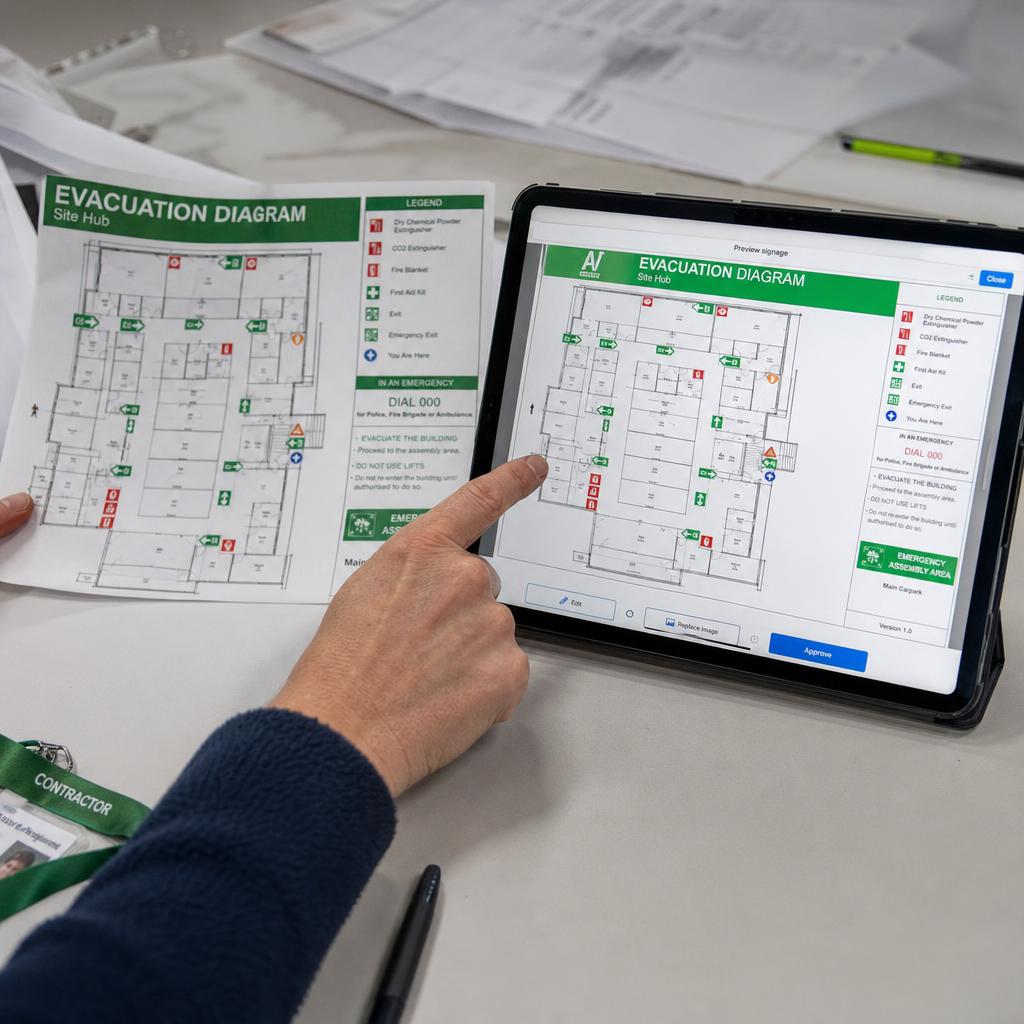
Work health and safety signage obligations do not disappear because a sign is displayed digitally instead of printed.
If you are considering replacing static safety signage with a screen — an evacuation map, a hazard warning — confirm with a WHS advisor:
- Whether the sign must remain permanently visible, which a rotating playlist may not guarantee
- Whether it must meet specific size, colour or symbol standards
- What happens if the screen loses power or fails
That last point is a real operational risk rather than a hypothetical one. A legally required safety sign that has gone dark due to a technical fault is still a sign that is not there.
The safe general approach is to keep formally required safety signage on dedicated always-on screens or permanent static signage, and reserve rotating playlists for informational and promotional content.
4. Advertising Standards for Promotional Content
Where signage displays promotional content, the general advertising standards that apply to any public advertising in Australia apply equally: accuracy, not being misleading, and any industry-specific codes relevant to what is being promoted.
The medium does not change the obligation. What is said on a screen still has to meet the same standard as what would be said anywhere else.
5. Data Hosting and Residency
Where your signage platform stores and processes data matters to some organisations a great deal and to others not at all. It becomes a live question when you have specific data governance requirements, work in a regulated sector, or answer to a procurement process that asks.
Worth establishing before you commit to a platform:
- Which country the content, user accounts and logs are actually stored in
- Whether any data is processed or replicated offshore
- What the vendor can put in writing about it
SPARC hosts in Australia on AWS infrastructure in Sydney, which is usually the first thing an Australian procurement process asks about.
Compliance Areas at a Glance
| Compliance area | What it concerns | Where it's most relevant |
|---|---|---|
| Accessibility | Contrast, text size, not relying on colour alone | Any public-facing screen, especially government or public services |
| Privacy | Data collected via cameras, sensors, or analytics features | Signage with audience analytics or occupancy sensors |
| Workplace safety | Statutory safety and hazard signage obligations | Emergency information, hazard warnings, evacuation maps |
| Advertising standards | Accuracy and honesty of promotional content | Any screen displaying promotional or marketing content |
| Data hosting and residency | Where signage platform data is stored and processed | Businesses with specific data governance requirements |
Build a Compliance-Aware Process, Not a One-Off Check
A review done once at installation goes stale quickly. A new analytics feature gets switched on, a screen gets repurposed for safety content it was never intended for, or advertising content changes without anyone re-checking it.
Businesses that manage this well generally do three things:
- Name someone responsible for signage compliance questions, rather than leaving it to whoever happens to notice a problem
- Review new features before switching them on, particularly anything involving analytics or data collection
- Keep a simple record of what each screen displays and why, so a review does not mean reverse-engineering the fleet from scratch
None of this replaces legal advice specific to your business and jurisdiction. It is a framework for the questions worth raising with your own advisor, not a substitute for that conversation.
Where a Digital Signage Platform Can Help
A compliant deployment starts with a platform that shows you what is actually running and what data is being collected.
SPARC's platform is built and hosted in Australia, keeps audit trails of what was displayed and when, requires approval before content goes live, and lets you pull anything instantly. Book a demo and we will walk through it against your own compliance requirements.
Digital signage compliance FAQs
Is digital signage legally required to meet WCAG accessibility standards in Australia?
It depends on the context — some public-facing digital services and government signage have specific accessibility obligations, while private commercial signage may not have the same formal requirement. Regardless of the strict legal position, WCAG-aligned practices like sufficient contrast and readable text sizing are widely regarded as good practice. Confirm your specific obligations with a compliance advisor rather than assuming either way.
Does digital signage with audience counting need to comply with the Privacy Act?
If the signage collects or processes any information that could relate to identifiable individuals, the Australian Privacy Principles may apply, depending on your business's size and specific circumstances. Aggregate, anonymised counting is generally lower-risk than anything involving facial recognition or stored footage, but the specifics should be confirmed with a privacy advisor.
Can I replace a printed safety sign with a digital screen?
Possibly, but confirm with a WHS advisor first. Safety signage obligations generally require the information to remain visible and legible, which can be complicated by a screen that's part of a rotating content playlist or that loses power. Many businesses keep statutory safety signage on dedicated always-on displays rather than mixing it into general rotation.
Do advertising standards apply differently to digital signage than to printed advertising?
No — the general principle is that advertising standards around accuracy and not being misleading apply to the content regardless of the medium it's displayed on. A claim that wouldn't be acceptable on a printed poster isn't made acceptable by being displayed on a screen instead.
Who is responsible for digital signage compliance within a business?
This varies by organisation, but it's worth explicitly assigning rather than leaving unowned. Because compliance spans marketing (content and advertising standards), IT (data and privacy), and facilities or WHS (safety signage), a single named point of accountability — even informally — tends to prevent issues falling through the gaps between departments.
Does where my digital signage platform hosts its data matter for compliance?
It can, particularly for privacy and data governance purposes. Some businesses prefer or require platforms that host data within Australia. This is worth raising directly with your signage vendor and confirming against your own business's data governance policies.
How often should digital signage compliance be reviewed?
There's no fixed universal schedule, but a practical approach is to review compliance whenever a new feature is added (particularly analytics or data collection), whenever screen usage changes (for example, a screen starts displaying safety content it wasn't originally intended for), and as a periodic check-in independent of any specific trigger, since standards and obligations can change over time.