Choosing business signage is one of those decisions that seems straightforward until you start. Then you discover dozens of options, conflicting advice, and prices ranging from $200 to $200,000. This guide cuts through the confusion with a systematic approach to signage decision-making.
Whether you're opening a new business, refreshing an existing location, or scaling across multiple sites, these principles apply.
Step 1: Define Your Signage Objectives
Before comparing sign types or getting quotes, clarify what you need signage to accomplish.
Primary Identification
Goal: People looking for you can find you
Requirements:
- Business name clearly visible
- Street number/address if applicable
- Visibility from relevant approach directions
- 24-hour visibility if open outside daylight
Typical solutions: Fascia sign, pylon/monument sign, building identification
Attraction
Goal: Capture attention from people not specifically looking for you
Requirements:
- Stand out from surroundings
- Communicate what you offer quickly
- Create positive first impression
- Visible from vehicle speeds (if applicable)
Typical solutions: Illuminated signs, LED displays, window graphics, A-frames
Information Delivery
Goal: Communicate specific information (menus, services, directions)
Requirements:
- Legibility at relevant viewing distances
- Flexibility if information changes
- Appropriate detail level for context
- Compliance requirements (pricing, hours)
Typical solutions: Menu boards, directories, informational panels, digital displays
Wayfinding
Goal: Help people navigate your premises
Requirements:
- Decision point coverage
- Consistent design language
- Accessibility compliance
- Updates when layout changes
Typical solutions: Directional signage, directories, room identification
Brand Building
Goal: Reinforce brand image and values
Requirements:
- Brand guideline compliance
- Quality reflecting brand positioning
- Consistency across locations
- Memorable, distinctive presence
Typical solutions: Premium materials, distinctive design, digital experiences
Step 2: Assess Your Context
Location Analysis
Street frontage:
- Width of exposure
- Setback from street
- Traffic speed (pedestrian, vehicle, or both)
- Competing signage nearby
- Lighting conditions
Building type:
- Shopfront in strip
- Shopping centre tenancy
- Standalone building
- Industrial/commercial premises
- Heritage or character area
Visibility obstacles:
- Trees or landscaping
- Street furniture
- Adjacent buildings
- Seasonal changes
Audience Analysis
Who needs to see your signage:
- First-time visitors
- Regular customers
- Passing traffic
- Delivery drivers
- Emergency services
How they're travelling:
- Walking: Detail readable at 3-10 metres
- Driving slowly: Key message readable at 30-50 metres
- Driving fast: Bold identification only at 50-100+ metres
What they need:
- Confirmation they're in the right place
- Information to make a decision
- Directions to proceed
Regulatory Context
Council requirements:
- Signage policy for your zone
- Size restrictions
- Illumination restrictions
- Heritage overlays
- Development Application requirements
Building requirements:
- Body corporate approvals
- Landlord approvals
- Shopping centre guidelines
- Strata restrictions
Industry requirements:
- Mandatory information displays
- Advertising standards
- Professional body guidelines
Step 3: Evaluate Sign Types
The Signage Menu
Permanent mounted signs: | Type | Visibility | Best For | Approval Needed | Price Range | |------|------------|----------|-----------------|-------------| | Fascia | 20-50m | Primary ID | Usually yes | $1,500-$15,000 | | Pylon | 50-200m | Road visibility | Yes | $5,000-$50,000 | | Monument | 20-50m | Entrance ID | Usually yes | $4,000-$30,000 | | Blade | 10-30m | Pedestrian strip | Sometimes | $800-$8,000 | | Awning | 5-20m | Shopfront canopy | Sometimes | $500-$5,000 |
Window and surface graphics: | Type | Visibility | Best For | Approval Needed | Price Range | |------|------------|----------|-----------------|-------------| | Cut vinyl | 3-15m | Text/logos | Rarely | $200-$1,500 | | Printed graphics | 3-30m | Full colour | Rarely | $300-$3,000 | | Perforated vinyl | 3-30m | Full coverage | Sometimes | $500-$4,000 | | Frosted film | 2-10m | Privacy/branding | Rarely | $200-$2,000 |
Portable and temporary: | Type | Visibility | Best For | Approval Needed | Price Range | |------|------------|----------|-----------------|-------------| | A-frame | 5-20m | Daily specials | Sometimes | $150-$800 | | Banner stand | 2-10m | Events/promos | Rarely | $100-$500 | | Flags/teardrop | 10-50m | Attention/events | Sometimes | $150-$600 |
Digital signage: | Type | Visibility | Best For | Approval Needed | Price Range | |------|------------|----------|-----------------|-------------| | Window display | 3-20m | Dynamic promos | Sometimes | $2,000-$8,000 | | Menu board | 2-10m | Changing menus | Rarely | $1,500-$5,000 | | Video wall | 5-50m | High impact | Yes | $15,000-$100,000+ | | LED message | 30-200m | Road visibility | Yes | $5,000-$50,000 |
Step 4: Traditional vs Digital Decision
Choose Traditional When:
Static content: Your message doesn't change (or changes less than quarterly)
Heritage/restriction: Council or landlord restrictions prohibit digital displays
Premium positioning: High-end brands sometimes prefer traditional craftsmanship
Simple identification: You just need people to know you're there
Tight budget: Lower upfront cost for basic signage needs
Choose Digital When:
Frequent changes: Content updates weekly or more often
Multiple messages: You need to communicate different things at different times
Promotions focus: Regular sales, specials, or limited-time offers
Measurability: You want to track what's being displayed when
Multi-location: Managing consistent messaging across multiple sites
Competitive advantage: Your industry hasn't adopted digital yet
The Hybrid Approach
Most businesses benefit from combining both:
Traditional for: Permanent brand identification, 24/7 visibility without power Digital for: Promotional messaging, menus, dynamic content
Step 5: Material and Quality Decisions
Quality Levels
Budget:
- Achieves basic function
- Shorter lifespan (2-5 years)
- May look dated quickly
- Appropriate for: Startups, temporary locations, tight budgets
Mid-range:
- Professional appearance
- Standard lifespan (5-10 years)
- Reasonable durability
- Appropriate for: Most retail, hospitality, services
Premium:
- Distinctive, high-quality appearance
- Extended lifespan (10-20+ years)
- Materials and finishes that impress
- Appropriate for: Flagship locations, premium brands, corporate
Cost vs Total Cost of Ownership
Cheap sign, expensive lifetime:
- $2,000 sign that fades in 2 years
- Replacement cost: $2,000
- Total 10-year cost: $10,000+
Quality sign, lower lifetime cost:
- $5,000 sign that lasts 10 years
- No replacement needed
- Total 10-year cost: $5,000
The lesson: Invest in quality for permanent signage.
Step 6: Get Quotes and Compare
What to Request
Detailed specifications:
- Materials for all components
- Finish types (paint, vinyl, powder coat)
- Illumination type and brightness
- Hardware and mounting
Inclusions checklist:
- [ ] Design and artwork
- [ ] Council permit application
- [ ] Fabrication
- [ ] Delivery
- [ ] Installation
- [ ] Electrical connection
- [ ] Certification
Warranty details:
- Workmanship warranty period
- Materials warranty
- What's covered and excluded
- Warranty claim process
Comparing Quotes
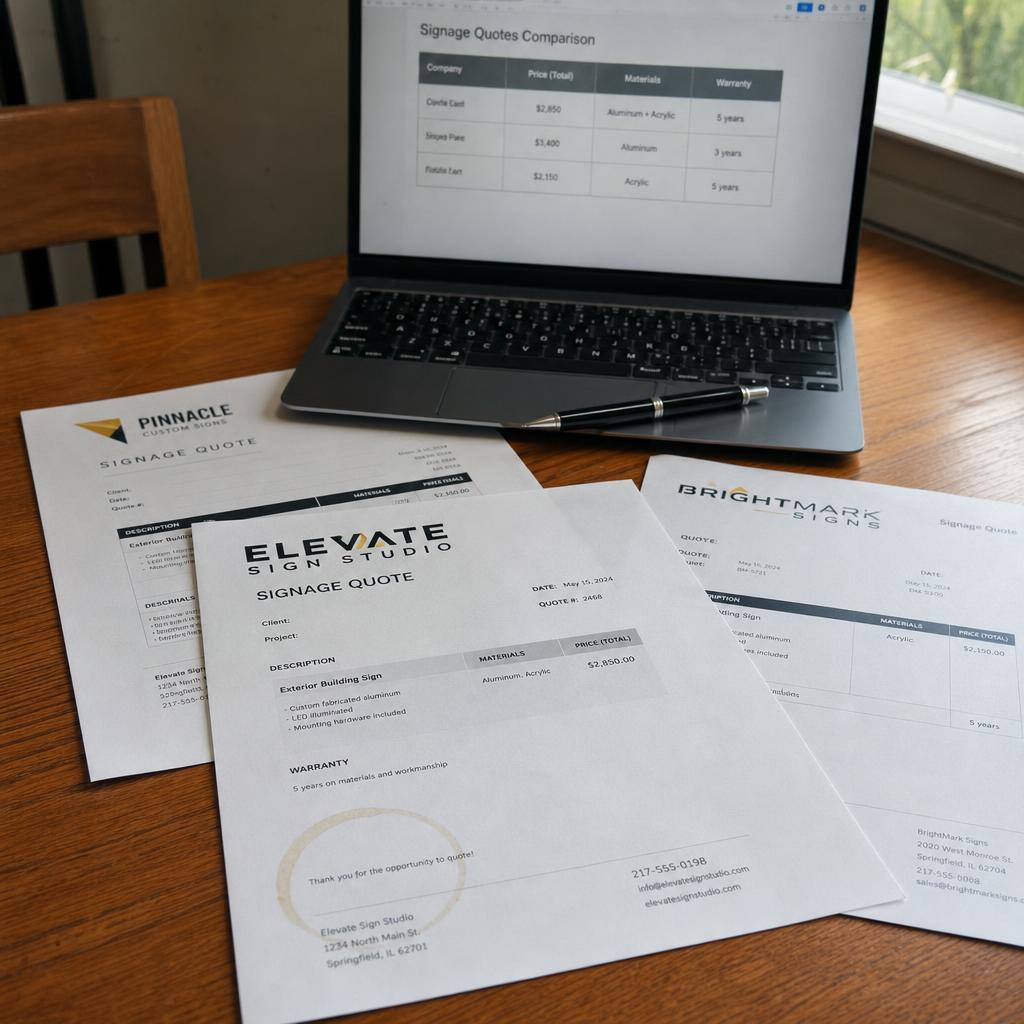
Don't just compare totals. A $5,000 quote without permits, installation, and electrical isn't cheaper than a $7,000 all-inclusive quote.
Create comparison table:
| Item | Quote A | Quote B | Quote C |
|---|---|---|---|
| Design | Included | $500 | Included |
| Permits | $300 | Not included | Included |
| Fabrication | $3,500 | $3,000 | $4,200 |
| Installation | Included | $800 | Included |
| Electrical | Not included | $500 | Included |
| Warranty | 12 months | 24 months | 36 months |
| True Total | $3,800+ elec | $4,800 | $4,200 |
Step 7: Implementation Timeline
Typical Project Phases
Planning (2-4 weeks):
- Define requirements
- Get quotes
- Select provider
- Finalise design
Approval (2-8 weeks, if required):
- Submit DA/permit application
- Council assessment
- Conditions (if any)
- Approval received
Production (2-4 weeks):
- Artwork finalisation
- Material procurement
- Fabrication
- Quality check
Installation (1-3 days):
- Delivery to site
- Installation
- Electrical connection
- Final inspection
Total typical timeline: 6-16 weeks from decision to installation
Rush Projects
Some providers offer expedited service: - Premium charges apply (20-50%+) - Limited to simpler sign types - May not be possible if council approval needed - Quality can suffer if rushed excessively
Making Your Final Decision
Decision Checklist
- [ ] Clear objectives defined
- [ ] Context fully assessed
- [ ] Multiple options considered
- [ ] Traditional vs digital determined
- [ ] Quality level appropriate for brand
- [ ] Multiple quotes compared properly
- [ ] Timeline achievable
- [ ] Budget realistic
- [ ] Provider reputation verified
Red Flags
- Pressure to decide immediately
- Quotes without site visit
- No portfolio of similar work
- Unclear warranty terms
- Large upfront deposits (>50%)
- No written contract
Green Flags
- Willingness to visit site
- Relevant portfolio examples
- Clear, detailed quotes
- Written warranty
- Reasonable payment terms
- Good communication throughout
---
Still not sure what signage you need? Digital signage from SPARC adapts as your needs change—start with one display and scale from there. Explore SPARC pricing to explore your options.
Common Signage Mistakes That Only Show Up After Installation
Even businesses that work through every decision carefully still run into problems they didn't anticipate. A few show up often enough to be worth flagging before you sign off on artwork and materials.
The most common is choosing sign size from the shopfront rather than the viewing distance. A sign that looks proportionate on a building elevation drawing reads as far too small once it is mounted three metres up and seen from a moving car 40 metres away.
Before finalising dimensions, stand at the furthest realistic viewing point and check the design is still legible there — not just on screen:
- The opposite kerb
- The entry to the car park
- The previous intersection
Colour is the second trap. Paint swatches, brand guidelines and screen colours don't always translate accurately to illuminated acrylic, vinyl or powder-coated metal. The same brand blue can look noticeably different lit from behind than it does printed on a business card. If colour accuracy matters to your brand, ask for a physical sample under the lighting conditions the sign will actually use — daylight and after dark — before committing to full production.
Council and landlord approval is the mistake with the most expensive consequences. Signs get ordered and fabricated before permits are confirmed, then can't be installed as designed, or need costly rework to comply with a body corporate's signage clause or a council overlay. Confirm approvals before production starts, not after the sign arrives.
Finally, businesses often underestimate ongoing access requirements. A sign mounted somewhere that needs scaffolding or a boom lift to clean or repair will cost more over its lifetime than a slightly less prominent position that a technician can reach with a ladder. Factor maintenance access into placement, not just visibility.
Signage as an Ongoing Line Item, Not a One-Off Purchase
It's easy to treat signage as a single transaction — get it made, get it installed, move on. In practice, signage behaves more like any other brand asset: it needs a maintenance budget, it ages, and it should be reviewed on a cycle rather than left until something breaks.
Split the spend into two categories:
1. The capital cost of the initial sign.
2. An ongoing allowance — typically a small percentage of that capital cost per year — covering:
- Cleaning
- Globe or LED replacement
- Minor repairs
- Eventual refresh of faded vinyl or panels
Businesses that budget for the second upfront rarely get caught out. Those that do not end up with a tired, half-lit sign, because there was never a line item to fix it.
Review signage whenever the business itself changes:
- A rebrand
- A new location
- An expanded product range
- A shift in trading hours — an unlit sign is dead weight for a business that trades into the evening
Treat signage as part of the marketing budget, reviewed at the same cadence as your website or your advertising spend. That keeps it working as hard as the rest of your brand rather than fading quietly in the background.
Choosing business signage: FAQs
How long does it typically take from ordering signage to installation?
Timelines vary considerably by sign type and complexity. Simple non-illuminated signs can sometimes be turned around in one to two weeks, while illuminated or custom-fabricated signage, especially anything requiring council approval, can take several weeks to a couple of months once design, approvals, fabrication and installation are all accounted for. It pays to start the process well ahead of any launch date or event you're working towards.
Do I need council approval for business signage?
In most cases, yes, though requirements vary significantly by council area, sign type and location. Illuminated signs, larger format signage, and anything projecting over a footpath typically require a permit. Some smaller, non-illuminated signs within existing shopfront areas may be exempt, but this depends entirely on local planning rules. Confirm requirements with your local council before finalising a design, since approval can affect size, placement and even colour.
What's the difference between a shopfront sign and a monument sign?
A shopfront sign is mounted directly on or above the building facade, typically at the entry to the business. A monument sign is a freestanding structure, usually set back from the building near the street or driveway, often used where the shopfront itself is set back from the road or where a business shares a site with others and needs its own street-level identification. Monument signs generally involve more substantial footings and construction than facade-mounted signage.
How often should illuminated signage be serviced?
As a general guide, an annual check is a reasonable minimum, covering globe or LED function, wiring integrity, and the condition of the housing and lenses. Businesses in coastal or high-UV locations may need more frequent checks, since sun and salt exposure can degrade seals and finishes faster than in sheltered inland locations. Regular servicing is usually far cheaper than letting a fault go unnoticed until the sign fails outright.
Can I reuse my existing sign structure when rebranding?
Sometimes, though it depends on the structure's condition and whether the new design fits the existing format. Cabinet-style illuminated signs can often have their faces replaced without rebuilding the whole structure, which can meaningfully reduce cost. However, if the rebrand changes the sign's proportions, lighting requirements or mounting method, a full replacement is usually more practical than trying to force a new design onto an old frame.
Is it worth paying more for a locally manufactured sign versus an imported or budget option?
This depends on your priorities. Locally manufactured signage generally offers easier warranty support, faster turnaround on repairs, and materials suited to Australian weather conditions. Budget or imported options can bring the upfront cost down but may involve longer lead times for replacement parts and less certainty around how materials will hold up locally. Weigh the difference against how long you expect the sign to remain in place and how much downtime a repair delay would actually cost you.
What questions should I ask a signage supplier before committing?
At minimum, ask about warranty terms and what they cover, who is responsible for council approvals, what the expected lifespan of the materials is in your specific location, and what ongoing maintenance the sign will need. It's also worth asking to see examples of similar work they've completed, and clarifying who to contact if something needs repair after installation. A supplier who can answer these clearly upfront is generally a good sign of how the rest of the project will go.