Looking for "shop signage near me"? You're not alone. Every day, thousands of Australian business owners search for local signage solutions to attract customers, build brand recognition, and drive sales.
But here's what most search results won't tell you: the signage landscape has fundamentally changed. While traditional sign makers still produce vinyl banners and illuminated boxes, the businesses seeing the biggest returns are investing in digital shop signage that can be updated instantly, scheduled automatically, and measured precisely.
This guide covers both options—helping you find the right signage solution whether you're opening a new shop in Sydney, refreshing your Melbourne storefront, or expanding across multiple locations.
Types of Shop Signage Available in Australia
Before searching for "signage near me," understand what's actually available:
Traditional Static Signage
Fascia Signs (Shopfront Signs) The classic illuminated or non-illuminated sign above your shop entrance. Prices range from $500 for basic vinyl to $15,000+ for custom illuminated 3D lettering.
Best for: Permanent branding, heritage areas with restrictions, one-time installation
Limitations: Can't be updated, no flexibility for promotions, requires physical changes for any modifications
A-Frame Signs (Sandwich Boards) Portable pavement signs for daily specials and foot traffic capture. Expect $150-$800 depending on size and materials.
Best for: Daily specials, directional guidance, temporary promotions
Limitations: Council permits often required, weather dependent, manual updates needed
Window Graphics Vinyl decals, frosted film, and printed graphics for shop windows. Pricing varies from $50/sqm for basic vinyl to $300/sqm for premium printed graphics.
Best for: Privacy, branding, semi-permanent promotional messaging
Limitations: Difficult to change, fades over time, blocks natural light
Digital Shop Signage
Window-Facing Digital Displays High-brightness LCD or LED screens visible from outside your shop, displaying dynamic content 24/7.
Investment: $2,000-$8,000 per screen plus content management software
Best for: Rotating promotions, time-sensitive offers, eye-catching motion content
Indoor Digital Menu Boards Particularly popular in QSR, cafes, and food retail—digital screens replacing printed menus.
Investment: $1,500-$4,000 per screen including mounting and basic software
Best for: Frequently changing menus, daypart pricing, upselling with imagery
Video Walls Multiple screens combined to create large-format displays for maximum impact.
Investment: $15,000-$100,000+ depending on size and technology
Best for: Flagship stores, high-traffic locations, brand experiences
Finding Shop Signage Providers Near You
Local Sign Makers: Pros and Cons
Advantages:
- Face-to-face consultation
- Local installation and service
- Understanding of local council requirements
- Support local business
Disadvantages:
- Limited to their capabilities (most don't do digital)
- Variable quality between providers
- Often higher prices than specialists
- May not understand retail marketing needs
How to Evaluate Local Sign Companies
When searching "signage near me" and reviewing local options, ask:
- Portfolio relevance – Have they done shops similar to yours?
- Council experience – Do they handle permit applications?
- Installation included – Is the quote comprehensive?
- Warranty terms – What happens if it fails?
- Ongoing support – Who do you call for changes?
Australian Sign Industry Associations
For vetted providers, check: - Signs Australia – Industry association with member directory - Australian Sign & Graphics Association (ASGA) – Trade body with standards - Master Builders Association – For signage integrated with construction
Digital Signage: The Modern Alternative
Here's the truth that local sign makers won't tell you: digital signage doesn't require a local provider.
Cloud-based digital signage platforms like SPARC allow you to:
- Order hardware online with next-day delivery across Australia
- Install yourself or use any local AV installer
- Manage content remotely from any device, anywhere
- Update instantly without calling anyone or paying for changes
- Scale effortlessly across multiple locations
Cost Comparison: Traditional vs Digital
Scenario: Cafe with 2 menu boards and 1 window display
Traditional signage: - Initial design and production: $4,500 - Installation: $800 - Annual updates (4 menu changes): $2,400 - 5-year total: $16,500
Digital signage: - 3 commercial displays: $6,000 - Mounting and installation: $1,200 - Software (5 years): $3,600 - 5-year total: $10,800 - Savings: $5,700 + unlimited free updates
The maths become even more compelling for businesses that update pricing, promotions, or menus frequently.
Shop Signage by Australian City
Sydney Shop Signage
Sydney council regulations vary significantly by Local Government Area:
City of Sydney: Strict heritage controls in areas like The Rocks, Paddington, Surry Hills. Digital signage often restricted to behind glass. Development Application may be required for illuminated signs.
Parramatta: More flexible, particularly in commercial zones. Good opportunities for digital displays in Western Sydney retail corridors.
Northern Beaches: Residential character restrictions limit signage size and illumination in many areas.
Finding signage in Sydney: Search "commercial signage Sydney" or specify your suburb. Alexandria and Marrickville have high concentrations of sign manufacturers.
Melbourne Shop Signage
Melbourne CBD: Heritage overlays affect significant portions of the central city. Many buildings have specific signage guidelines.
Inner suburbs (Fitzroy, Collingwood, Richmond): Creative industries presence means more acceptance of innovative signage, including digital.
Outer suburbs: Generally more permissive, with shopping centre signage often managed by centre landlords.
Finding signage in Melbourne: Signage manufacturers cluster in Bayswater, Dandenong, and Tullamarine industrial areas.
Brisbane Shop Signage
Brisbane City Council: Relatively straightforward approval process for most commercial signage. Digital signage well-accepted in commercial zones.
Gold Coast: Tourist-focused areas have specific character requirements. Digital displays popular in retail and hospitality.
Finding signage in Brisbane: Concentration of manufacturers in Northgate and Eagle Farm areas.
Perth Shop Signage
Perth CBD: Signage policy refreshed in 2023 with more flexibility for digital displays.
Fremantle: Heritage port city with strict controls—traditional signage often required.
Finding signage in Perth: Malaga and Welshpool industrial areas have most sign manufacturers.
Adelaide Shop Signage
Adelaide City Council: Proactive approach to retail activation, including digital signage in appropriate locations.
Suburban councils: Generally follow state planning guidelines with local variations.
What to Display on Your Shop Signage
Having the right sign is only half the equation—you need the right content.
Essential Shop Signage Content
- Business name and logo – Obvious, but ensure it's legible from expected viewing distances
- What you sell – Don't assume passersby know. "Specialty Coffee" beats just "Cafe"
- Opening hours – Digital signage can update automatically; static requires manual changes
- Key differentiator – What makes you worth stopping for?
Dynamic Content for Digital Signage
The power of digital signage is the ability to show:
- Time-based promotions – Morning coffee specials, happy hour, lunch deals
- Weather-triggered content – Hot drinks when cold, iced beverages when hot
- Stock availability – "Fresh croissants just baked" or "Tonight's special: 3 left"
- Social proof – Live review feeds, Instagram content, customer testimonials
- Urgency messaging – "Closing in 30 minutes – 20% off remaining stock"
Content That Drives Foot Traffic
Research shows these content types generate the highest engagement:
- Motion – Even subtle movement captures attention 5x more than static images
- Faces – Human faces (especially eyes) draw viewer attention
- Contrast – High-contrast text is readable from distance
- Limited text – 7 words or fewer for window-facing displays
- Call to action – "Come in for..." or "Ask about..." directs behaviour
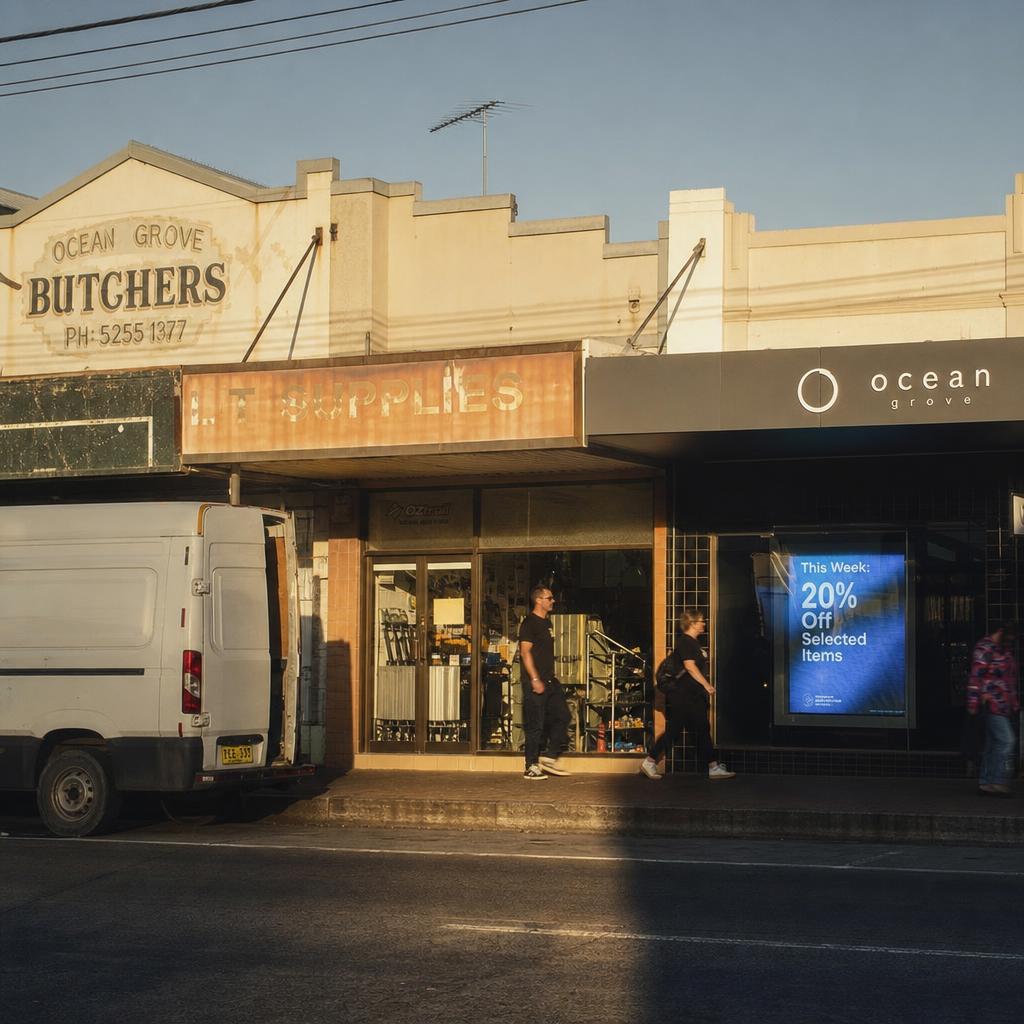
Installation and Permits
Council Approval Requirements
Most Australian councils require approval for:
- Illuminated signs
- Signs projecting over footpaths
- Signs above certain sizes (typically 2.5m²)
- Digital/electronic displays
- Heritage area installations
Typical approval timeline: 2-8 weeks depending on complexity and council workload.
Costs: $200-$1,500 for Development Application fees.
DIY vs Professional Installation
DIY suitable for:
- A-frame and portable signage
- Small window graphics
- Tabletop digital displays
- Simple wall-mounted screens (if comfortable with tools)
Professional installation required for:
- Any electrical work (legal requirement—must be licensed electrician)
- Fascia signs at height
- Large window graphics
- Video walls and complex configurations
- Anything structural
Making Your Decision
Choose Traditional Static Signage If:
- You're in a heritage-restricted area
- Your branding and offerings rarely change
- Budget is extremely tight (under $1,000 total)
- You only need basic identification signage
Choose Digital Shop Signage If:
- You have promotions, specials, or changing inventory
- You want to capture attention with motion
- You're managing multiple locations
- You update pricing or menus regularly
- You want to measure what works
Getting Started with SPARC
SPARC makes digital shop signage accessible for Australian retailers of any size:
- Simple hardware – We recommend commercial-grade displays that work out of the box
- Cloud management – Update your signs from your phone, tablet, or computer
- No contracts – Month-to-month software subscriptions
- Australian support – Real people in your timezone
Whether you're replacing a tired lightbox with a dynamic display or rolling out digital signage across a franchise network, SPARC provides the platform that grows with you.
---
Ready to upgrade from static to digital? Explore SPARC pricing and discover why Australian retailers are making the switch to smart signage.
How Long Does Shop Signage Take: Design to Installation
One of the most common questions we get isn't about price — it's about timing. If you've got a shop opening date locked in, or a lease that requires signage within a set window, the timeline matters as much as the design.
For most traditional jobs — a single shopfront sign, window vinyl or an illuminated box — expect roughly one to two weeks from final artwork sign-off to installation, assuming no council permit is required.
Add permit processing on top if your council needs to approve the sign. That runs anywhere from a couple of weeks to over a month, depending on:
- The council
- Whether the site is heritage-listed or in a designated precinct
Vehicle wraps typically take longer to install than static signs, since the vehicle needs to be off the road for one to three days depending on wrap coverage (partial vs full wrap) and vinyl complexity. Book these in advance if the vehicle is your only one — most sign makers can advise on loan or staggered scheduling if you run a small fleet.
Digital signage installation is usually faster on the physical side (mounting a screen is quicker than fabricating and fixing a static sign) but can be slowed by electrical work, content setup, and network configuration if it's your first digital display.
The biggest delay isn't fabrication — it's artwork approval. Sign makers can only start production once you've signed off on final proofs, so the fastest path to installation is having your logo files, brand colours, and any required wording ready before you request a quote, rather than working it out during the quoting process.
What to Expect From Your Signage Over Time
Shop signage is a visible, weather-exposed asset, and how long it lasts depends heavily on materials and location. Vinyl graphics and printed banners typically hold their colour and finish for three to five years before fading becomes noticeable, particularly on signs facing direct afternoon sun. Solid substrates like aluminium composite panels and acrylic-faced light boxes generally outlast vinyl by a wide margin, often remaining serviceable for a decade or more with only occasional cleaning.
Illuminated signage has an added consideration: LED modules and transformers are wear items. Most LED signage is rated for tens of thousands of hours of operation, but connections, seals, and power supplies are worth a visual check every year or two, especially after storm season, to catch water ingress or flickering before it becomes a full replacement job.
A quick seasonal wipe-down with mild detergent keeps most signage looking sharp. Avoid high-pressure washers directly on vinyl edges or seams — that lifts the film over time.
Address these early rather than waiting until the whole sign needs replacing:
- Peeling corners
- Bubbling
- A section of LED going dark
Ask your sign maker at installation whether they offer touch-up repairs — re-adhering a lifted edge, replacing a single LED strip. Not every supplier services what they install.
Shop signage FAQs
How much does shop signage cost in Australia?
Cost depends on size, materials, and whether the sign is illuminated or digital, so there's no single figure that applies across the board. The most reliable way to get a realistic number is to request quotes from a few local suppliers with the same brief, so you're comparing like-for-like rather than guessing from a general price range.
Do I need council approval to install a shop sign?
Often, yes, particularly for anything projecting over a footpath, illuminated after certain hours, or located in a heritage overlay or designated shopping strip. Some minor window signage and temporary displays are exempt, but requirements vary by council, so it's worth checking with your local council's planning department or asking your sign maker whether they handle permit applications on your behalf.
How long does it take to get shop signage made and installed?
For a standard shopfront sign without permit requirements, budget one to two weeks from final artwork approval to installation. If council approval is needed, add that processing time on top. Vehicle wraps and larger illuminated installations can take longer, so it pays to enquire early rather than leaving it until just before opening day.
Can I keep my current signage up while the new one is being made?
Generally yes — fabrication happens off-site, so your existing sign stays in place until the new one is ready to fit. The only downtime is usually the installation window itself, which for most static signs is a matter of hours rather than days.
What's the difference between illuminated and non-illuminated signage?
Illuminated signage uses internal or external lighting (LED modules, neon-style tubing, or backlighting) to remain visible after dark, which matters if your shop trades into the evening or sits on a street with lower ambient lighting. Non-illuminated signage relies on daylight and street lighting, costs less upfront, and has no electrical components to maintain.
Do I need to supply my own artwork and logo files?
Most sign makers can design from scratch, but if you already have a logo or brand guidelines, supplying high-resolution vector files (AI, EPS, or PDF) speeds up the process considerably. Low-resolution logos pulled from a website often need to be redrawn, which adds time to the quoting and proofing stage.
How often will I need to replace my shop signage?
It depends on the material. Vinyl graphics and printed elements typically need refreshing every three to five years as UV exposure causes fading, while solid substrates and well-maintained light boxes can last a decade or longer. Regular cleaning and prompt repair of small issues, like a lifted vinyl edge, extend the life of any sign considerably.