Why Isn't a Sydney Rollout Just 'Digital Signage, But in Sydney'?
Because one Sydney brand is usually running three or four different content problems under one postcode.
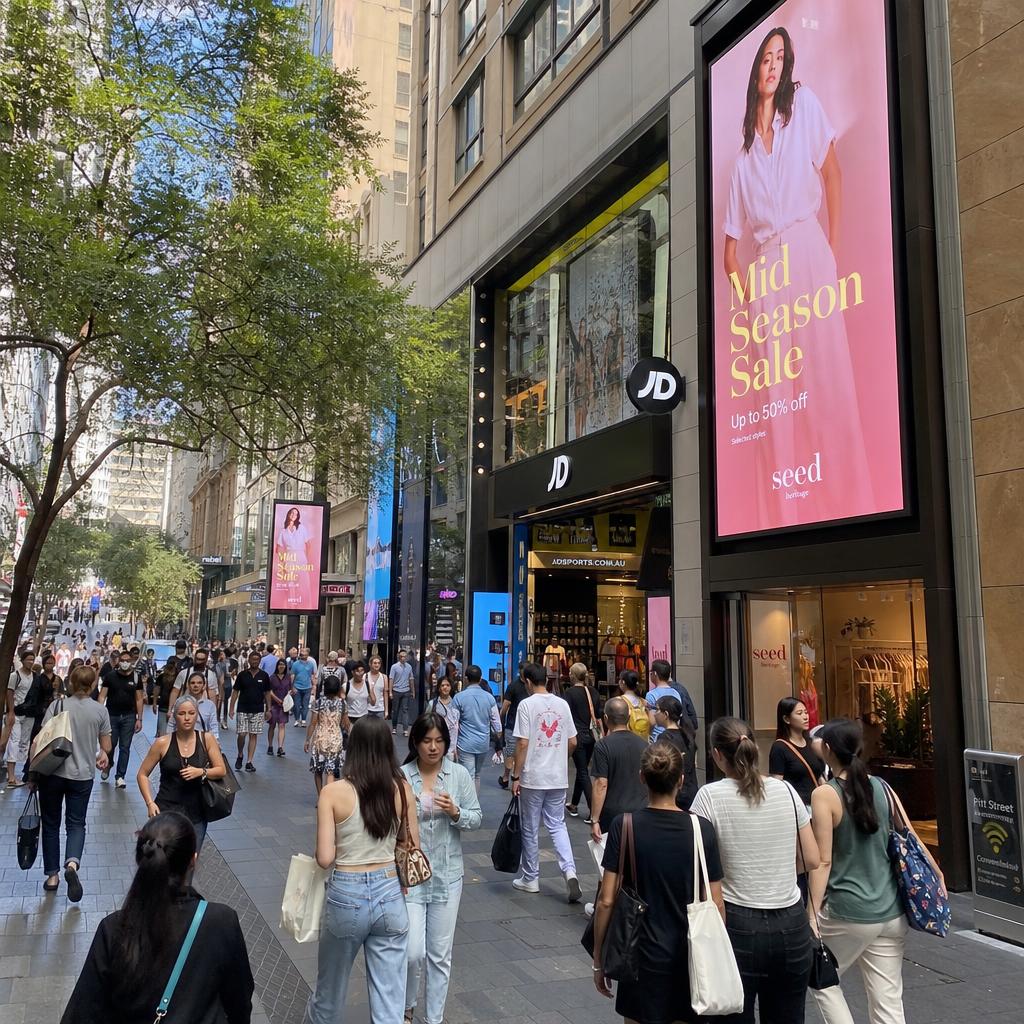
A Pitt Street Mall or George Street flagship sees a volume and pace of foot traffic most Australian retail never encounters. Content has to earn attention in seconds, refresh often enough to stay relevant across a trading day, and never sit dark during the hours that generate the most revenue in the calendar.
A Chatswood or Bondi Junction centre unit runs the same brand playbook against a different rhythm — weekday commuters, weekend families, and a mall-management schedule dictating trading hours the store does not control.
A Barangaroo or Circular Quay site targets tourists and finance-precinct lunch trade, where the content mix — multilingual signage, high-end product storytelling — looks nothing like a suburban strip.
None of that is exotic. It just means planning for three or four scheduling problems before locking in a single template for every site.
Sydney's Retail Precincts Aren't One Market
A few precinct patterns come up repeatedly when Sydney retailers plan a signage network:
- CBD core (Pitt Street Mall, George Street, Westfield Sydney): highest footfall, shortest attention window, and the greatest value from dayparted content — breakfast and coffee offers before 9am, lunch-trade promotions from 11:30, after-work retail pushes from 5pm.
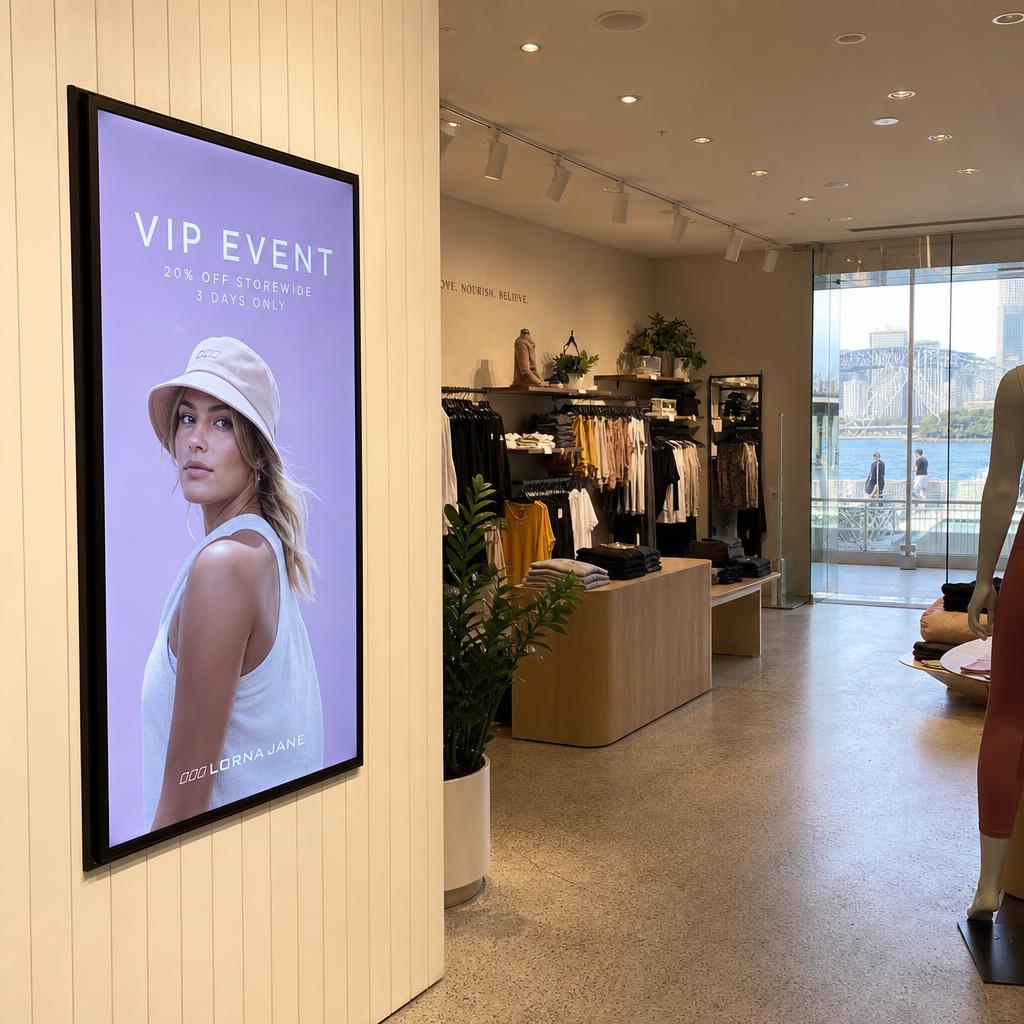
- Barangaroo and Circular Quay: a mixed local-and-tourist audience close to the finance precinct, where premium in-store screens and window displays do more brand storytelling and less hard promotion.
- North Shore and Eastern Suburbs malls (Chatswood, Bondi Junction): centre-management trading hours and shared common-area screens alongside your own tenancy signage — worth confirming compatibility with the centre's existing AV infrastructure before committing to hardware.
- Western Sydney growth corridors (Parramatta, Penrith, Blacktown): newer retail developments with a younger, more price-sensitive demographic and, increasingly, multilingual community audiences that benefit from rotating-language content.
The common thread: a single static playlist pushed to every Sydney location under-serves at least two of these precincts. Screen-group scheduling — different playlists for different store clusters, all managed from one dashboard — is the feature that actually matters here, more than any single flashy display technology.
What Does Sydney's Coastal Air Do to Outdoor Screens?
Corrodes them, faster than the same unit would degrade inland.
Screens near the harbour foreshore, the Eastern Beaches, or anywhere within a few kilometres of open water are exposed to airborne salt that attacks enclosures, connectors and mounting hardware.
For any outdoor or forecourt deployment in those areas, specify from day one:
- Marine-grade or IP65-rated enclosures
- Corrosion-resistant fixings
Retrofitting after the first summer causes a fault is the expensive path.
Sydney's humid subtropical summers also push ambient-light and heat requirements similar to Brisbane's: high-brightness panels with automatic adjustment keep content legible at midday without overheating in direct January sun.
Inland Western Sydney faces the opposite extreme — dry heat above 40°C during heatwaves. Hardware specified for one part of the Sydney basin is not automatically right for another.
A Short Checklist Before You Sign a Sydney Signage Contract
- Does the platform support screen-group scheduling, so CBD, mall-tenancy, and suburban sites can run genuinely different content on the same dashboard?
- Is outdoor or near-harbour hardware specified with marine-grade, corrosion-resistant enclosures — not a generic outdoor rating chosen for an inland climate?
- Can menu and pricing content update centrally and instantly, so NSW labelling and pricing requirements never lag a head-office decision?
- Does the vendor's data residency and support actually sit in Australia, or does a Sydney rollout end up routed through an overseas time zone for both hosting and support?
- If you're in a shopping centre, has the platform been checked against the centre's own AV standards before hardware is ordered?
Answering these before committing avoids the two most common Sydney-specific regrets: hardware that corrodes near the coast within a year, and a single generic playlist that under-performs in every precinct it's forced to serve equally.
SPARC answers yes to every item on that checklist, and we are happy to be asked about each one. Book a demo and we will run through the list against your actual Sydney sites — CBD flagship, mall tenancy and suburban stores on one dashboard.
Case Studies
Retail
Challenge
A multi-site Sydney fashion retailer ran the same static playlist across a Pitt Street Mall flagship, a Chatswood Westfield tenancy, and a Parramatta store, and found CBD promotions underperformed while suburban stores displayed content irrelevant to their weekend-family customer base.
Solution
Split the network into three screen groups on one SPARC dashboard — CBD, mall-tenancy, and growth-corridor — each with its own dayparted schedule, while keeping brand assets and approvals centralised.
Result
CBD screens now run lunch-hour and after-work dayparted promotions, mall screens align with centre trading hours, and Parramatta runs family-oriented weekend content — all managed by one Sydney-based marketing coordinator without extra headcount.
Sydney retail digital signage FAQs
Does digital signage need to be different for a Sydney CBD store versus a suburban Sydney mall?
Functionally yes. A CBD site benefits from short, high-frequency dayparted content built for fast foot traffic, while a suburban shopping-centre tenancy needs to work within centre-management trading hours and often alongside shared common-area screens. Screen-group scheduling from one platform handles both without duplicating effort.
Do outdoor screens near Sydney Harbour or the beaches need different hardware?
Yes. Coastal salt air accelerates corrosion on enclosures and connectors, so outdoor or near-harbour installations should use marine-grade, IP65-rated hardware with corrosion-resistant fixings rather than a generic outdoor rating chosen for an inland climate.
Is SPARC's digital signage platform available for Sydney retailers?
Yes. SPARC operates Australia-wide from a Melbourne headquarters, with data hosted on AWS Sydney (ap-southeast-2) and support in Australian time zones. See the [Digital Signage Sydney](/digital-signage-sydney) page for the full local overview.
How do I choose signage hardware for a mix of CBD, coastal, and Western Sydney sites?
Specify hardware per site condition rather than one standard everywhere: corrosion-resistant enclosures near the coast, high-heat-tolerant outdoor units for Western Sydney's summer extremes, and standard indoor players for CBD and mall tenancies.
Ready to Experience SPARC?
Join forward-thinking organizations already using SPARC for their digital signage needs.