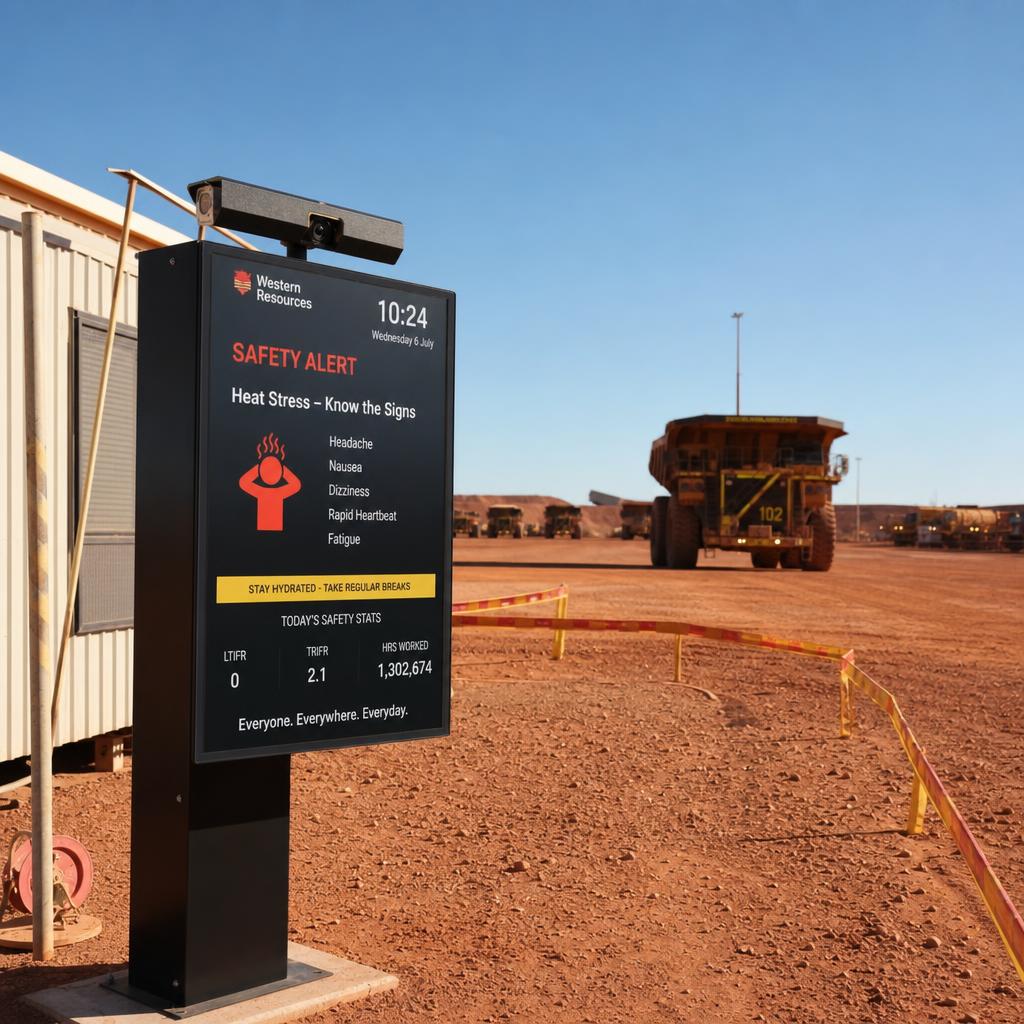
Why Is a WA Resources Deployment Really Two Deployments?
Talk to a Perth operations team about digital signage and you are usually talking about two deployments at once.
The corporate office — CBD or West Perth. Lobby screens, meeting-room signage, workplace communications. Not meaningfully different from a corporate rollout in any other Australian capital.
The sites — safety and operational displays across the Pilbara, Goldfields and Kimberley. Often hundreds of kilometres from the nearest fibre, staffed by a FIFO workforce on rotating rosters.
Those two environments need almost entirely different hardware and connectivity assumptions. A platform that only handles the first one well is solving half the problem.
What Happens to Signage When the Connection Drops?
On a remote site, it has to keep playing. That is not a preference, it is the whole requirement.
A site near Karratha or Port Hedland may run on satellite backhaul, or a mine-site network shared with operational systems that take priority. A digital sign is rarely first in line for bandwidth.
That makes local content caching non-negotiable:
- The player downloads and stores content ahead of time
- It keeps playing its last-scheduled playlist through a connectivity drop
- It never depends on a live stream a satellite link cannot reliably sustain
This matters most for safety communication. Evacuation instructions, muster-point signage and shift-change briefings have to display correctly during exactly the kind of outage a remote site is most likely to experience.
A platform that cannot guarantee offline playback is not a safety-grade fit for a Pilbara camp, whatever else it does well.
What Hardware Spec Do Resources Sites Actually Need?
Outdoor and semi-outdoor screens on a resources site face a harsher combination than almost any other Australian commercial environment:
- Direct sun and ambient temperatures regularly above 40°C through summer
- Fine airborne dust from unsealed roads and processing activity
- Vibration from nearby heavy machinery or transport routes
That points to a specific spec rather than a general "outdoor" rating:
- High-IP-rated sealed enclosures, to keep dust out of ventilation paths
- High-brightness panels with automatic ambient-light adjustment, to stay legible in direct sun
- Mounting rated for vibration, not a standard indoor bracket
Camp accommodation and mess-hall screens run in a controlled indoor environment closer to standard corporate spec. The mistake to avoid is applying one hardware standard uniformly across a site that actually has two or three distinct micro-environments.
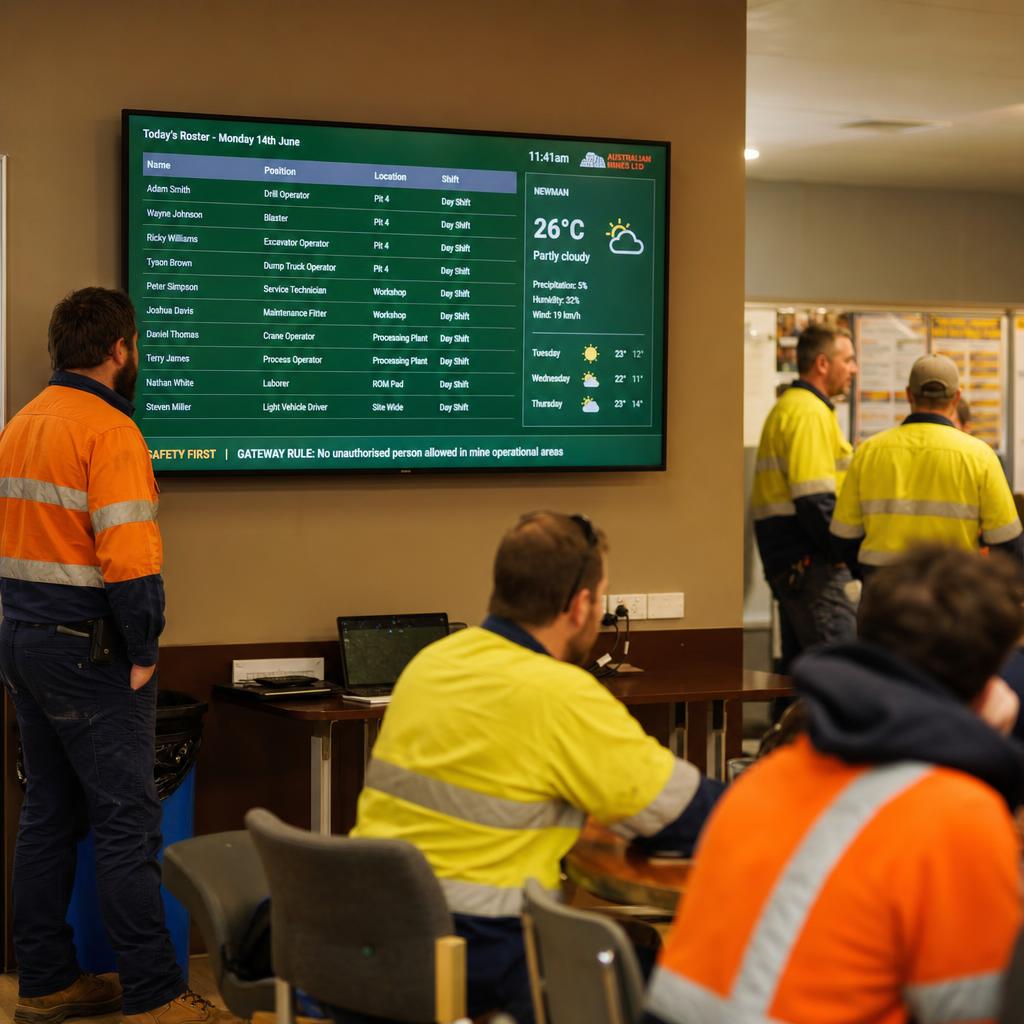
How Do You Schedule Content Around a FIFO Roster?
Against shift patterns, not a business-hours calendar.
A FIFO workforce does not experience a single trading day. Shift changes, camp meal times and safety briefings run on a roster that rotates through day and night continuously.
Content in camp common areas, mess halls and muster points needs to carry:
- Safety messaging relevant to an incoming night shift
- Roster and transport information for outgoing crews
- Camp notices that stay current regardless of which crew is on site that week
Multi-site resources companies also need one dashboard covering both a metro Perth office and a scattered set of remote camps. A genuinely centralised platform means a safety or operations update goes out once and reaches every location, rather than being re-sent separately to each site's local IT contact.
A Short Checklist Before You Sign a WA Resources Signage Contract
- Does the platform cache content locally and keep playing through a connectivity drop, rather than depending on a constant live connection?
- Is hardware specified per micro-environment — dust- and heat-rated for outdoor/plant areas, standard indoor spec for camp and office areas — rather than one blanket outdoor rating?
- Can content be scheduled against shift rosters rather than only a standard business-hours calendar?
- Can safety and muster-point content be pushed as a priority override across every remote site from one dashboard during an incident?
- Does support operate in Australian time zones, so a fault at a remote WA site during an early shift doesn't wait on an overnight overseas queue?
Getting these right upfront avoids the two failure modes most common in WA resources deployments: signage that goes blank the moment a remote link degrades, and hardware that fails within a season because it was specified for an office, not a mine site.
SPARC answers yes to every item on that checklist, including offline playback that keeps running through a connectivity drop. Book a demo and we will walk the list against your own sites, whether that is a Perth office, a remote village or a site office on intermittent satellite.
Case Studies
Manufacturing
Challenge
A WA resources company ran safety and camp-notice signage across a Perth head office and several remote Pilbara sites, but screens at two remote camps regularly went blank during satellite connectivity drops, and content wasn't adjusted for night-shift crews.
Solution
Deployed players with local content caching so remote screens kept playing through connectivity gaps, and set up shift-pattern scheduling so muster and safety content stayed relevant across day and night rosters, all managed from one dashboard in the Perth office.
Result
Remote camp screens no longer go dark during network drops, safety messaging reaches both day and night crews correctly, and the Perth ops team pushes updates to every site — metro and remote — in one action instead of contacting each site separately.
Perth digital signage FAQs
Can digital signage work reliably at a remote WA mine site with limited connectivity?
Yes, provided the platform caches content locally on the media player ahead of time rather than depending on a constant live connection. That way a screen keeps playing its last-scheduled content — including safety and muster information — through a satellite or network outage.
Does outdoor signage need special hardware on a Pilbara or Goldfields site?
Yes. Direct sun, temperatures regularly above 40°C, airborne dust, and in some cases equipment vibration all call for high-IP-rated, sealed, high-brightness hardware — a standard indoor or generic outdoor unit typically won't hold up in these conditions.
Can signage content be scheduled around FIFO shift rosters instead of business hours?
Yes. Content in camp common areas, mess halls, and muster points can be scheduled against shift patterns, so safety messaging and camp notices stay relevant regardless of which crew is on site.
Can one platform manage both a Perth CBD office and remote resources sites?
Yes. A single centralised dashboard can run standard corporate content for a metro office alongside safety- and roster-driven content for remote camps and sites, so updates go out once rather than being managed separately per location.
Is SPARC's digital signage platform available for Perth and WA resources companies?
Yes. SPARC operates Australia-wide from a Melbourne headquarters, with data hosted on AWS Sydney (ap-southeast-2) and support in Australian time zones. See the [Digital Signage Perth](/digital-signage-perth) page for the full local overview.
Ready to Experience SPARC?
Join forward-thinking organizations already using SPARC for their digital signage needs.