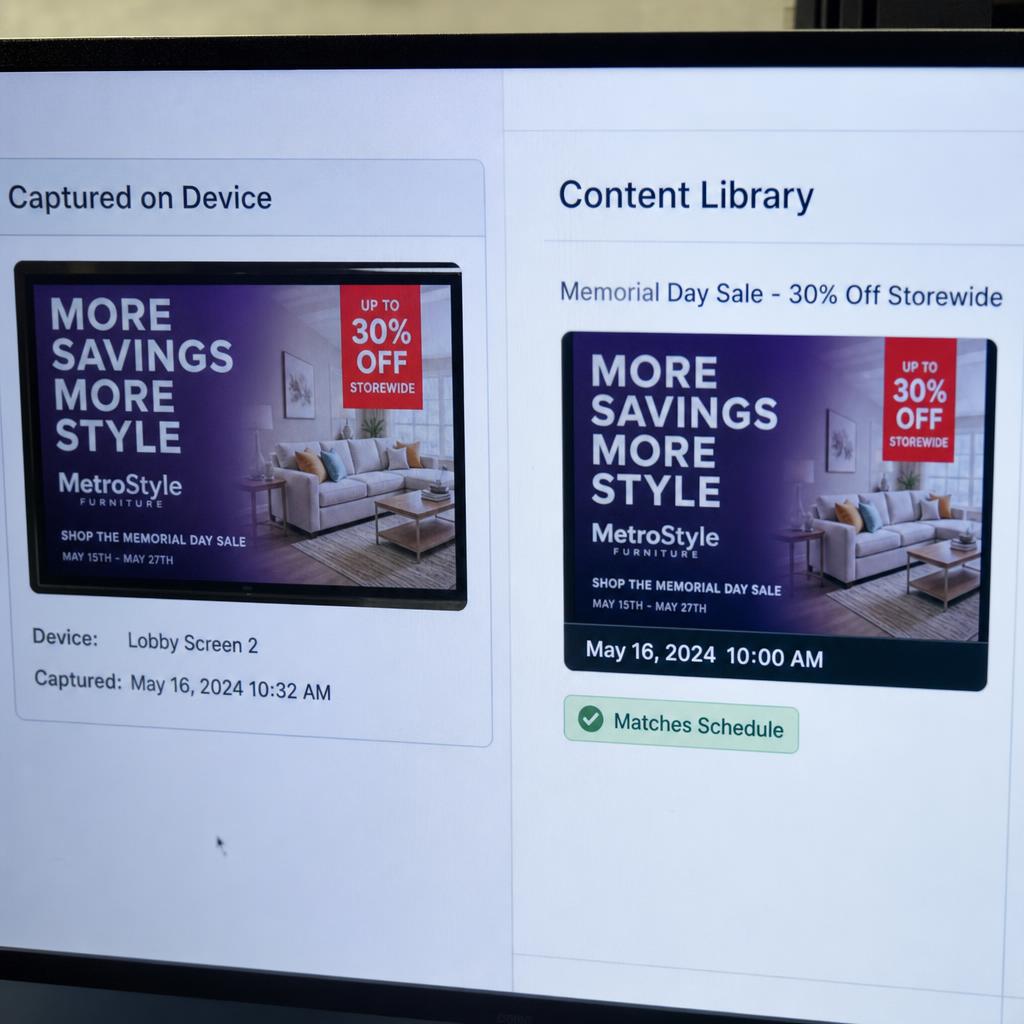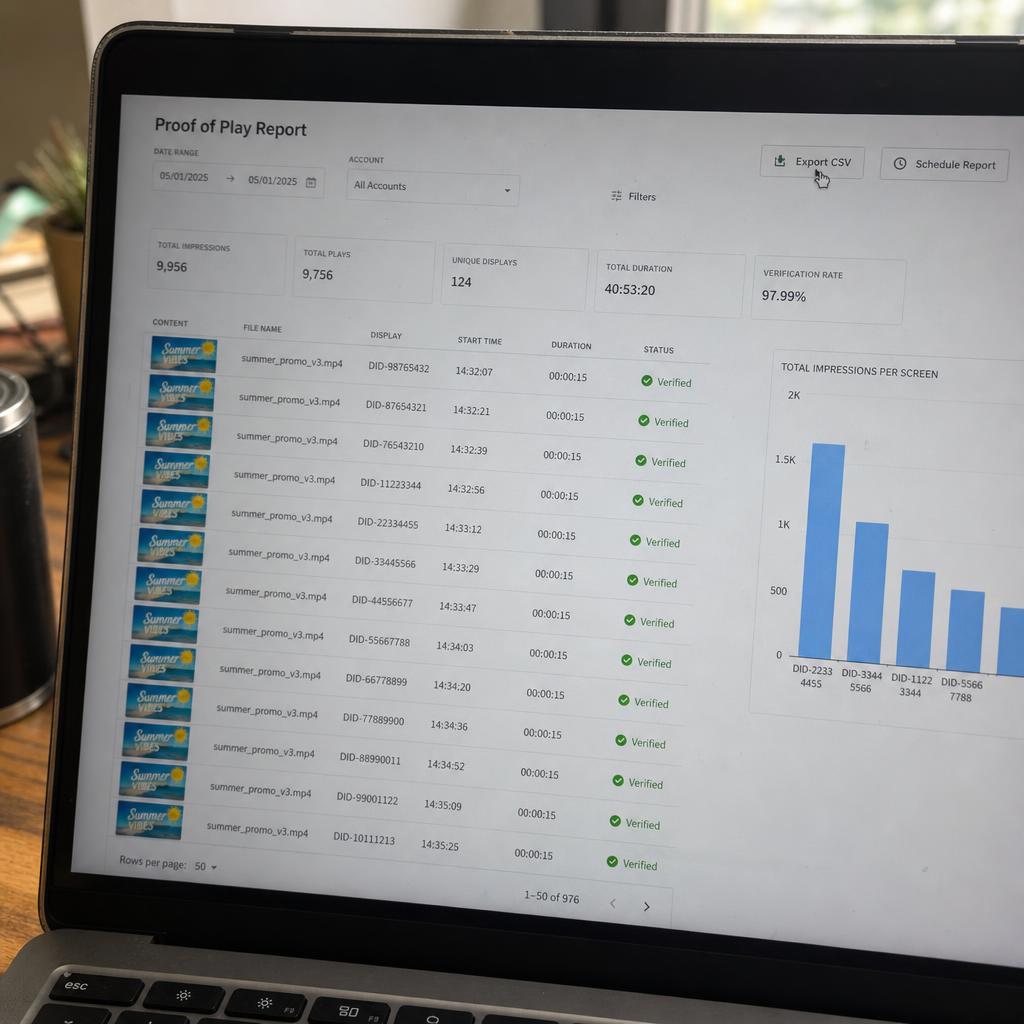
Proof of play is the audit trail of a screen network. It answers a question that sounds simple and is surprisingly hard without it: did the content we scheduled actually appear, on the right screens, at the right times?
What a proof-of-play report contains
| Field | Why it matters |
|---|---|
| Content name and version | Proves which creative ran, not just that something ran |
| Start time, end time, duration | The billable unit for advertising and the evidence for compliance |
| Play count | How many times the item appeared in the reporting period |
| Screen and location ID | Ties playback to a physical place, not just a device |
| Zone | On a multi-zone layout, which part of the screen carried it |
| Player status during playback | Distinguishes "played" from "played while the screen was off" |
| Errors and interruptions | Explains the gaps before someone else has to ask about them |
Screenshot capture is the strongest form: an image of the screen at the moment of playback, which settles disputes that a log alone cannot.
Why advertisers require it
Advertising on screens is sold on airtime or impressions. Without playback records, the buyer is paying on trust and the seller has nothing to defend an invoice with. Proof of play is what makes the transaction auditable in both directions: the advertiser reconciles what they bought against what ran, and the network operator can bill with evidence attached.
For anyone reselling screen time — retail media, venue sponsorship, place-based advertising networks — this is not a reporting nicety. It is the product.
Where compliance teams use it
- Healthcare: evidence that required patient notices and safety information were displayed.
- Financial services: records that rate or disclosure content appeared in branch for the required period.
- Transport and public facilities: confirmation that safety and service messages ran during an incident.
- Franchise networks: proof that a promotion a franchisee paid into actually ran in their market.
In each case the value is the same: turning "we think it was up" into a record with timestamps.
Proof of play versus audience analytics
These get conflated on sales calls, and they answer different questions.
| Proof of play | Audience analytics | |
|---|---|---|
| Question answered | Did the content run as scheduled? | Did anyone look at it, and who? |
| Source | The player's own playback log | Sensors or cameras at the screen |
| Used for | Billing, compliance, dispute resolution | Content performance, dwell time, engagement |
| Required by | Advertisers, auditors | Marketers, merchandisers |
A network can have excellent proof of play and no idea whether content worked, or the reverse. Advertising-funded networks need both: one to bill, one to sell the next campaign. More on digital signage analytics.
What to check before you trust a report
- Does it reconcile automatically? Scheduled versus actual, flagged where they differ — not two lists you compare by eye.
- Is playback confirmed by the player, or assumed by the server? A server can only prove it sent the content. The player proves it played.
- Does it record screen state? Content playing to a powered-off display should not count.
- Can you export it? If it cannot leave as a file or through an API, it will not survive an audit or a finance process.
- How long is it retained? Match retention to your longest contract or compliance window, not to the default.
How SPARC records it
SPARC players report playback back to the platform continuously: what played, on which screen, when, and for how long, alongside the device's health at the time. Reports can be exported for billing or compliance, and reconciled against what was scheduled. The mechanics of the delivery chain are in how digital signage works.