A dealership runs on information that changes constantly: drive-away pricing, stock levels, finance offers, model-year changeovers.
It also runs on a layout doing three different jobs at once:
- Sell the car on the showroom floor
- Sell the finance in the back office
- Keep customers informed while their vehicle is in for a service
Generic signage software built for retail or hospitality treats all of that as one problem. It is not one problem.
Dealership signage has to solve for pricing accuracy under a compliance microscope, brand storytelling that can carry a vehicle launch, and operational messaging in a service department that has nothing to do with marketing at all.
This post covers what each zone actually needs.
Why Is a Stale Price Worse Than No Screen at All?
In most retail, a screen showing yesterday's promotion is a minor embarrassment.
In a dealership it is a credibility problem:
- A drive-away price next to a car that has already been sold
- Worse, a price that no longer matches the finance contract
The number on the wall becomes evidence in a conversation with a customer who is about to sign. It is the same category of risk that rate-accuracy failures create on financial-services signage.
Pricing and stock live in a dealer management system and change through the day as vehicles are sold, transferred or repriced.
Signage pulling from a static playlist, or updated by whoever is at the front desk, will always lag behind.
The fix is not more diligence from staff. It is connecting the display platform to the systems of record, so pricing, availability and specification flow through automatically rather than being retyped.
If your platform cannot consume a feed or connect by API to your DMS, inventory feed, or a middleware layer already aggregating that data, every screen on the floor is one missed update away from a compliance and trust problem.
More on this in Digital Signage API Integrations.
What Do Spec and Pricing Displays Need?
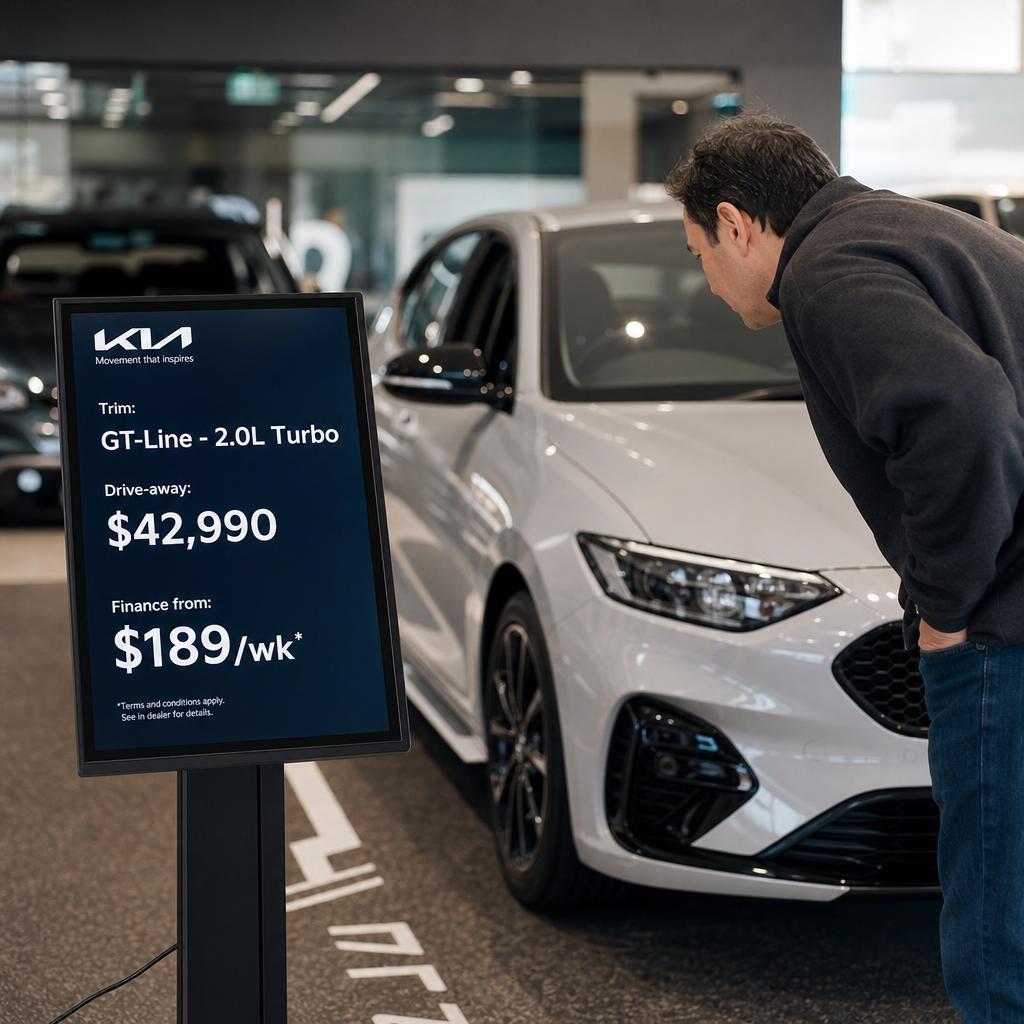
Beyond the accuracy problem, spec and pricing displays next to individual vehicles have their own design requirements. A shopper standing in front of a car wants confirmation of what they're looking at — trim level, engine, colour code, on-road costs, finance-from figures — without having to flag down a salesperson to check. That means:
- Per-vehicle or per-bay displays that can be reassigned quickly when stock moves, rather than being hard-wired to one physical position
- Clear separation between manufacturer-mandated pricing disclosures and dealer-added content (accessories, finance offers), since franchise agreements often dictate exactly how drive-away pricing must be presented
- A content refresh cycle tight enough that a sold vehicle can be pulled or relabelled within the same day, not the same week
- Fallback content for vehicles awaiting delivery or in transit, so a bay never sits on a screen showing incorrect or blank data
None of this needs to be flashy. It needs to be correct, current, and fast to update at the scale of a lot on the floor.
What Does a Showroom Video Wall Need to Do?
Where spec displays are about accuracy, the hero wall is about impression.
Vehicle launches, model-year reveals and OEM brand campaigns are where large-format video does what a single screen cannot: wrap a customer in the brand before they have spoken to anyone.
A well-run wall lets a dealership run manufacturer launch content at full scale for a campaign window, then step back to always-on brand content between events — without an AV technician on site to reconfigure it each time.
The requirement that gets missed is content provenance.
- OEM marketing teams supply assets in different formats, aspect ratios and resolutions depending on the franchise
- A multi-brand dealer group may run two or three manufacturers' launch materials in the same showroom precinct
A platform that maps content across a video-wall canvas correctly regardless of source format — without the dealership's marketing team re-encoding every asset by hand — is doing a genuinely different job to a single spec screen.
See Video Walls for how canvas mapping and multi-screen synchronisation work.
What Does the F&I Office Need Instead?
Once a customer moves from the showroom floor into the finance and insurance (F&I) office, the content job changes completely. This is a smaller, quieter, one-on-one environment, and the screen in that room isn't competing for attention against a showroom full of vehicles — it's supporting a conversation about numbers a customer is about to commit to.
F&I office displays typically need to show:
- Current finance rates and product terms, pulled from the same source of truth as any printed or digital paperwork, so nothing on the wall contradicts what's in the contract
- Extended warranty, service plan, and insurance product summaries relevant to the vehicle being purchased
- Trade-in or valuation information where applicable
- No promotional showroom content — a launch video looping behind a customer signing finance paperwork is a tone mismatch, not brand reinforcement
This room's content has direct financial consequences, which makes it the clearest case in the dealership for permissions to matter. It has to work in both directions:
- The F&I manager should not be able to accidentally push showroom marketing into this zone
- Marketing should not be able to push a promotional offer that has not been checked against current finance terms
Zone-level content permissions — not just screen groups, but who may publish what into which zone — are worth testing before you buy, not treating as an afterthought.
Service department displays: operational, not promotional
The service department is where digital signage does the least marketing and the most genuinely useful work. Customers dropping a vehicle off or waiting in a service lounge care about one thing: where their car is in the process and roughly how long it'll be. Repair-order status boards, express-lane queue displays, and courtesy-vehicle or loan-car availability screens are operational tools first.
That said, the service waiting area is one of the few places in a dealership where a customer sits still for twenty minutes to an hour with nothing to do. That makes it a legitimate secondary opportunity for service-specific messaging:
- Upcoming maintenance reminders
- Accessory offers
- Seasonal check campaigns
As long as it does not crowd out the status information they actually came to check. The two content types should not compete for the same screen real estate — a status board and a promotional screen work better as separate zones than blended into one rotating playlist.
Managing content across a multi-site, multi-franchise dealer group
Most of the operational complexity shows up once you are past a single site. Australian dealer groups frequently run several franchises — a Toyota dealership, a Mazda dealership, a Hyundai dealership — sometimes from adjacent buildings on one precinct, sometimes across metro and regional locations.
Each franchise arrives with its own:
- Brand guidelines
- Approved imagery
- Logo usage rules
- OEM-supplied campaign content
Getting any of that wrong on-screen is a franchise compliance issue, not a style preference.
That creates a genuine governance problem:
> How does a group marketing team push one promotion across twelve sites, while each franchise's brand content stays inside that manufacturer's guidelines and never bleeds into a competing franchise's showroom?
The practical answer is layered permissions with zone and group structures — three layers:
- Head office pushes group-level content and enforces brand compliance centrally
- Individual sites keep a locked-down layer for local content — a local promotion, a community event, local pricing variance
- Franchise-specific content stays walled off from other franchises, even when they share a site
This is the same enterprise display management problem retail chains and financial-services branch networks face, with franchise compliance layered on top. We go into the underlying architecture in Enterprise Display Management.
Content by showroom zone
| Zone | Primary content | Update frequency | Key requirement |
|---|---|---|---|
| Entrance / brand wall | Video wall brand storytelling, launch campaigns | Campaign-based (weeks) | Multi-format canvas mapping, OEM asset compatibility |
| Vehicle display bays | Spec sheets, drive-away pricing, finance-from figures | Daily / as stock changes | DMS or inventory feed integration, no manual re-entry |
| Finance & Insurance office | Finance rates, product terms, warranty summaries | As rates/products change | Accuracy matching contract paperwork, no promotional content |
| Service department | RO status, queue/wait times, courtesy vehicle availability | Real-time / continuous | Separate zone from promotional content, DMS/workshop system link |
| Service waiting lounge | Maintenance reminders, seasonal offers (secondary) | Weekly / seasonal | Must not obscure status information |
What to look for when evaluating a platform
Treat this less as a features checklist and more as a fit test against the operations above:
- Can it connect to your DMS, inventory feed, or workshop management system via API, or will pricing and status always be manually entered?
- Does it support true zone-level permissions, so F&I, service, and showroom marketing content can't overwrite each other by accident?
- Can it handle a video wall canvas alongside standard single-screen displays in the same deployment, without needing separate tools?
- Does it support multi-site, multi-franchise group structures with centralised brand compliance and local content control?
- Is content management practical for the people actually running it day to day — service advisors, F&I managers, on-site marketing coordinators — not just a head-office CMS specialist?
SPARC is built and hosted in Australia, with AWS Sydney infrastructure, which matters for dealer groups wanting local support and data residency rather than routing every screen update through an overseas platform. You can see how this applies specifically to showroom environments on our automotive industry page.
Car dealership digital signage FAQs
Does digital signage need to connect to our dealer management system (DMS)?
It doesn't strictly have to, but if pricing, stock, or vehicle specification data is being retyped manually onto screens, you're carrying real risk of a stale or incorrect price being shown to a customer. Connecting signage to your DMS or inventory feed via API means the data on screen reflects what's actually in the system of record, updated automatically as stock and pricing change.
Can one platform run both showroom video walls and simple spec screens?
Yes, provided the platform supports canvas mapping for multi-screen video walls alongside standard single-display content in the same account. Running these as separate systems usually creates more management overhead than it saves, particularly for a marketing team already managing brand compliance across multiple screens.
How do we stop finance office screens showing showroom marketing content?
This comes down to zone-level content permissions rather than just screen groups. The platform should let you restrict what content types and campaigns can be scheduled into a defined zone, so promotional content physically can't be pushed into the F&I office, and finance-specific content can't leak onto the main showroom floor.
We operate multiple franchises from one dealer group — can signage keep brand content separated?
Yes, this is a core requirement for multi-franchise groups. Content and templates for one manufacturer's brand guidelines need to stay walled off from another franchise's content, even when screens sit in the same building or precinct, while group-level campaigns and local site content are still managed centrally.
What should service department screens actually show?
Primarily operational information: repair order status, estimated wait times, express-lane queue position, and courtesy or loan vehicle availability. Promotional content (service reminders, seasonal offers) can run in the same waiting area but works better as a separate zone or screen so it doesn't obscure the status information customers came to check.
Do vehicle launch videos need to be re-edited for our screens?
It depends on the platform's canvas handling. A capable system should be able to map OEM-supplied launch video and campaign assets across a video wall or standard displays without your marketing team manually re-encoding every file for a different aspect ratio or resolution, though asset quality from the manufacturer still varies.
How is this different from the showroom content covered on the automotive industry page?
The automotive industry page covers the showroom experience SPARC supports at a product level. This post goes deeper into the operational requirements behind it — pricing accuracy, video wall mechanics, F&I and service department content, and multi-site franchise governance — for anyone evaluating a platform rather than browsing features.
If you're assessing digital signage for a dealership or dealer group and want to see how zone permissions, video wall canvases, and DMS integration actually work in a live environment, book a demo and we'll walk through it against your own showroom and service layout.