If you are an AV integrator, experience designer or digital signage reseller, the platform you build on is not just a product decision. It is an operational and business-model decision.
The right digital signage software for AV integrators has to do more than play content on a screen. It has to:
- Let you manage dozens of separate client accounts from one login
- Support whatever hardware each job calls for
- Generate as few support tickets as possible
- Reward you for the clients you keep, not only the ones you sign
Get it wrong and you end up doing consumer-software support work at enterprise-project margins.
This is the question we hear most from integrators evaluating SPARC. Not "does it look good on a screen", but "can I actually run a business on top of this?"
Why This Decision Is Different From Picking Software for One Client
Most digital signage buying guides are written for the end customer choosing a platform for their own network. That is a different decision from yours.
You are not evaluating one deployment. You are evaluating the platform you will stand behind for every client you onboard over the next several years.
A platform that is fine for a single site can fall apart across fifteen client accounts with different hardware, different approval workflows and different levels of technical skill. The questions shift:
- From "does this feature exist" to "does this scale across accounts I do not administer day to day"
- From "is it easy to use" to "what happens to my support queue when something breaks at 2am in a site I have never visited"
That is the lens the rest of this is written through.
Five Things Digital Signage Software for AV Integrators Has to Do
- Manage many client accounts from one login, properly walled off
- Run on whatever hardware the job calls for
- Keep the support burden low enough to stay profitable
- Pay recurring revenue, not a one-off referral fee
- Back the commercial arrangement with actual infrastructure
1. Multi-Tenant Account Management Sets Your Growth Ceiling
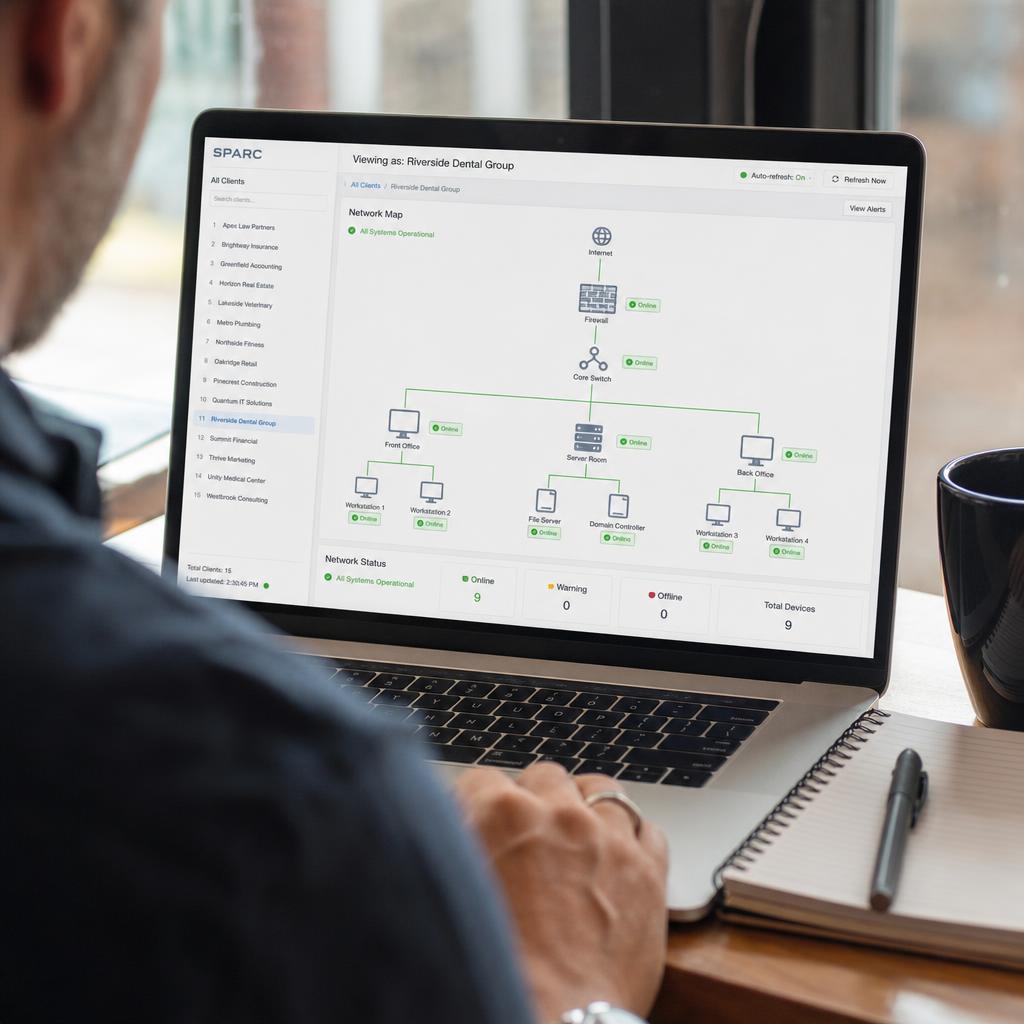
The biggest structural difference between a platform built for integrators and one that merely tolerates them is multi-tenant account management: administering many separate, walled-off client accounts from one login, where each client sees only their own screens, content and users.
Without it you have two bad options:
- A separate login per client. You juggle a growing credential list, logging in and out to check networks or push changes. This stops scaling past a handful of clients, and becomes a genuine security problem when staff turn over.
- Everyone in one shared account. Client A's team can potentially see client B's screens, content and player list. That does not survive the first prospect who asks how their data is separated from your other customers.
A genuine multi-tenant structure lets you:
- See your entire client base from one dashboard
- Drill into any account to troubleshoot or configure
- Hand each client a permissioned space where they manage their own content without seeing anyone else's
That is the difference between reselling software and running a managed service.
2. Hardware Flexibility Protects Your Margin
Every integrator has clients with different budgets, different existing hardware and different procurement rules. A platform locked to one proprietary media player forces you to walk away from jobs where that hardware does not fit, or absorb the cost of hardware that does not match the client's needs.
Software that runs across a range of commercial media players and displays gives you room to:
- Spec the right hardware per job, matching budget, display type and existing infrastructure
- Avoid being tied to one supplier's price list and stock availability
- Bring a client's existing screens and players into a new deployment rather than mandating a full refresh
That last one is often the difference between winning and losing the work. Hardware flexibility is not a technical nicety — it is what lets you compete on the recommendation that is right for the client rather than the one your software forces on you.
Worth reviewing a platform's integrations and supported hardware before committing to it as your primary stack.
3. The Support Burden Is the Line Item Nobody Puts in the Proposal
Every integrator learns this eventually: the sale is the easy part. The support relationship decides whether a client is profitable over the life of the contract.
A platform generating a steady stream of "screen is blank", "content didn't update" and "player is offline" tickets turns every client into a cost centre, whatever the margin looked like at signing.
What actually reduces that burden:
- Remote diagnostics — see a player's connection status, storage and playback state from your dashboard, without a truck roll or talking a client's receptionist through checking a cable
- Reliable uptime and playback — content and schedules that survive network interruptions instead of needing a manual reset
- Client-facing simplicity — an interface non-technical client staff can use for routine content changes, while you keep administrative control
- Sensible alerting — knowing a player is offline before the client notices, rather than finding out when they ring
None of this eliminates support work. It changes its shape. Instead of firefighting connectivity and playback, your team's time goes to content strategy, network expansion and the relationship that justifies a retainer.
4. Recurring Revenue Beats a Referral Fee
Traditional AV project work is one-off: install, invoice, move to the next job. A recurring-revenue partner model changes that shape, because a subscription you resell or manage keeps generating revenue for as long as the client uses the platform.
That matters for four structural reasons, independent of any vendor's specific terms:
- It smooths cash flow. Project work is lumpy. Recurring software revenue is not, which makes forecasting and staffing easier.
- It rewards retention, not just acquisition. A one-off install pays once regardless of how long the client stays happy. A recurring model pays while the relationship holds, aligning your incentives with keeping their network running well.
- It builds enterprise value. A book of recurring revenue alongside project and hardware revenue is a materially more valuable business than one built entirely on installs.
- It funds the support relationship. Ongoing revenue gives you a reason to monitor a client's network proactively, rather than only appearing when something breaks and needs an invoice.
We will not quote margin or commission figures here. Those are terms to get directly and in writing from any vendor before committing, ours included. The structural case holds regardless of which platform you pick.
5. A Commercial Arrangement Needs Infrastructure Behind It
Plenty of digital signage tools are good software for a single business managing its own screens. Repackaging one for resale usually means retrofitting your own layer of account separation, password management and client hand-holding onto a product never designed to be operated by a third party.
The tell is the account structure. If a platform offers a referral fee and a logo but no infrastructure for administering multiple client accounts, that is consumer software with a commercial arrangement bolted on.
The cost shows up later:
- Every client interaction routes through a workaround
- Every new account is manual setup rather than a repeatable process
- Your team manages the platform's limitations instead of client relationships
A platform genuinely built for integrators is designed from the account structure up to be operated by someone other than the end customer. That is the thing worth checking before you commit.
Integrator-Friendly vs Single-Tenant Consumer Platform
| Requirement | Integrator-friendly platform | Typical single-tenant consumer platform |
|---|---|---|
| Client account structure | Multi-tenant — manage many separate, permissioned client accounts from one login | One account per client, or one shared account with no real separation |
| Hardware support | Works across a range of commercial media players and displays | Locked to one proprietary player or device |
| Support visibility | Remote diagnostics and status monitoring across all client players | Limited visibility; troubleshooting often requires being on-site or on the phone with the client |
This is the shortlist worth checking against before you build a service line on any platform.
What to Ask a Vendor Before You Build a Business on Their Platform
Before committing your business development time and client relationships, ask directly:
- Can I see and administer multiple client accounts from a single login, with each client's data genuinely separated?
- How is a new client account created — a repeatable process, or manual setup each time?
- What remote diagnostics do I get across every client player without being on site?
- What does the commercial arrangement include beyond a referral fee and a logo?
- What hardware can I spec, and can I bring a client's existing players into a deployment?
- What happens commercially if a client I introduced goes direct?
A vendor that can answer these clearly, with a real account structure to demonstrate rather than a roadmap, is a vendor you can build on.
Two related pieces worth reading before you commit: enterprise display management covers how multi-site account and permission structures work in practice, and digital signage API integrations covers how a platform connects into the rest of a client's stack.
Building a Signage Service Line on SPARC
SPARC is built for the integrator model rather than adapted to it: multi-tenant accounts, hardware-agnostic playback, remote diagnostics across every client player, and a recurring commercial structure rather than a referral fee.
If you are weighing up which platform to standardise on, book a demo and we will show you the account structure itself — several client accounts under one login — rather than a single-tenant demo that tells you nothing about running fifteen.
Frequently asked questions
What does "multi-tenant" mean in digital signage software?
Multi-tenant means one platform instance can host many separate client accounts, each with its own content, players, users, and permissions, fully separated from every other account, while an integrator or reseller can still administer all of them from a single login. It's the structural feature that lets you manage many clients without juggling separate logins or risking one client seeing another's content.
Is white-label digital signage software the same as a multi-tenant platform?
Not necessarily. White-labelling refers to branding the client-facing experience as your own rather than the software vendor's. Multi-tenancy refers to the underlying account architecture that separates and organises multiple clients. A platform can offer one without the other, though the strongest integrator offerings typically provide both.
How much technical support should I expect to provide as a reseller?
It varies by platform quality and by how much support you choose to bundle into your own service offering. A well-built platform with remote diagnostics, reliable playback, and simple client self-service tools reduces the volume of basic tickets significantly, freeing your team to focus on higher-value work like content strategy and network expansion rather than routine troubleshooting.
Do I need to lock clients into specific hardware to resell digital signage software?
No — and doing so can limit which jobs you're able to win. Platforms that support a range of commercial-grade media players and displays let you match hardware to each client's budget and existing infrastructure, including bringing existing screens or players into a new deployment where appropriate.
What should an integrator look for besides a referral fee?
Look for documented commercial terms, a genuine multi-tenant account structure you can administer, dedicated partner-level support separate from general customer support, and a repeatable process for onboarding new client accounts. A referral link alone isn't a partner program — it's an affiliate arrangement.
Can I manage clients on different subscription tiers or with different feature sets from one login?
On a platform built for integrators, yes — each client account can typically be configured and licensed independently, letting you tailor what each client has access to without affecting other accounts you manage.
How do I evaluate whether a platform will actually scale as I add more clients?
Ask to see the account structure directly, not just a demo of a single account's content management. Check whether onboarding a new client is a repeatable, documented process, whether reporting rolls up across your whole client base, and whether the vendor can point to integrators already running multiple accounts on the platform.