Digital signage trends today are not about screens getting bigger or brighter. That argument was settled years ago.
The real shifts are in the software layer, and they share one thing: capabilities that used to be premium add-ons are becoming baseline expectations, on hardware that in most cases has not needed to change at all. The screens look the same. What runs behind them does not.
Six Digital Signage Trends That Actually Matter
- AI audience analytics moves from add-on to default
- Environment-aware content replaces fixed schedules
- Signage converges with IoT and environment control
- Remote fleet management stops being a premium tier
- Proof-of-play becomes a buying requirement
- Media player hardware gets simpler
None of this is speculative. It is already showing up in vendor comparisons and procurement briefs across Australia.
1. AI Audience Analytics Moves From Add-On to Default
For years "AI-powered analytics" was the line item that pushed a quote into enterprise territory: a bolt-on camera, a separate dashboard, a six-week integration.
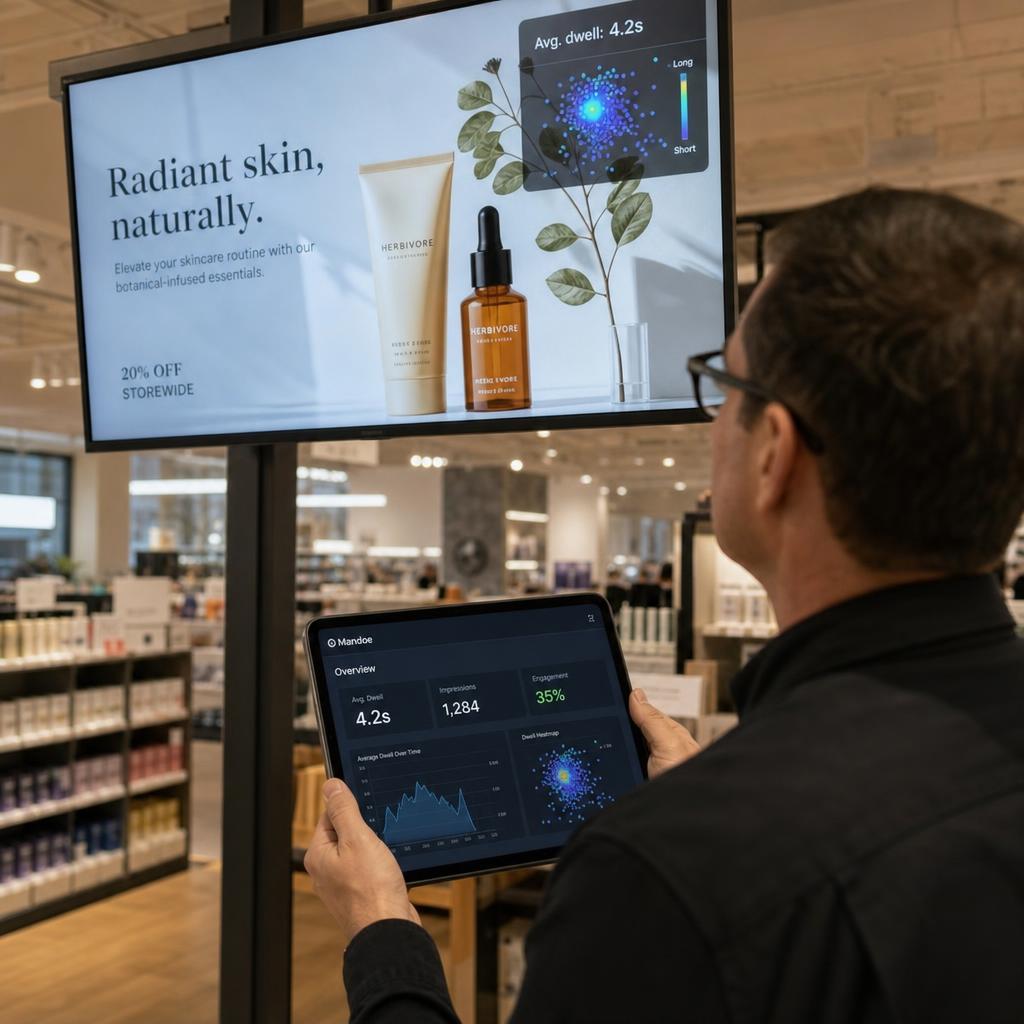
That is no longer how it works. Anonymous audience counting, dwell-time measurement and rough demographic bucketing now run on the same edge hardware that plays the content, feeding the same dashboard operators already use to schedule playlists.
The shift that matters: analytics has stopped being a report you check afterwards and started being an input that shapes what plays next. A screen seeing dwell time trend down on a loop can flag it before a marketing team notices the campaign has gone stale.
None of this requires facial recognition or stored imagery. The useful signal is aggregate counts and attention duration, not identity. Any platform worth evaluating should be explicit about processing on-device and discarding raw video rather than uploading it.
SPARC's AI audience analytics works this way: counts and dwell time roll up into reporting, nothing identifiable leaves the screen.
There is an operational angle that gets less attention than the marketing one. Retail and hospitality operators increasingly use the same dwell-time and traffic data for staffing and stock decisions, not just content performance. A screen that doubles as a low-cost foot-traffic sensor is an easier budget line than a screen that only displays a loop.
2. Environment-Aware Content Replaces Fixed Schedules
Content that changes because the room changed, not because a scheduler ticked into the next day-part.
- A cafe menu board pulling a sold-out item once the POS flags zero stock
- A corporate lobby screen swapping from wayfinding to a welcome when a booking system shows a visitor checking in
- A retail promo that plays once foot traffic crosses a threshold the store actually gets, rather than looping to an empty aisle
This is not generative AI improvising layouts. It is a rules engine reacting to real triggers: occupancy sensors, weather feeds, inventory APIs, calendar data.
The distinction matters when evaluating a platform. "Environment-aware" is an easy phrase for a features page and a much harder one to back with actual API hooks and a rules builder a non-developer can configure without raising a ticket.
The pattern holds outside retail:
- Transport and airports adjust wayfinding priority from live delay feeds rather than a static map
- Healthcare waiting rooms shift from general content to queue-specific information when a patient management system flags a room change
The trigger source changes by industry. Content responding to a live feed instead of a fixed clock does not.
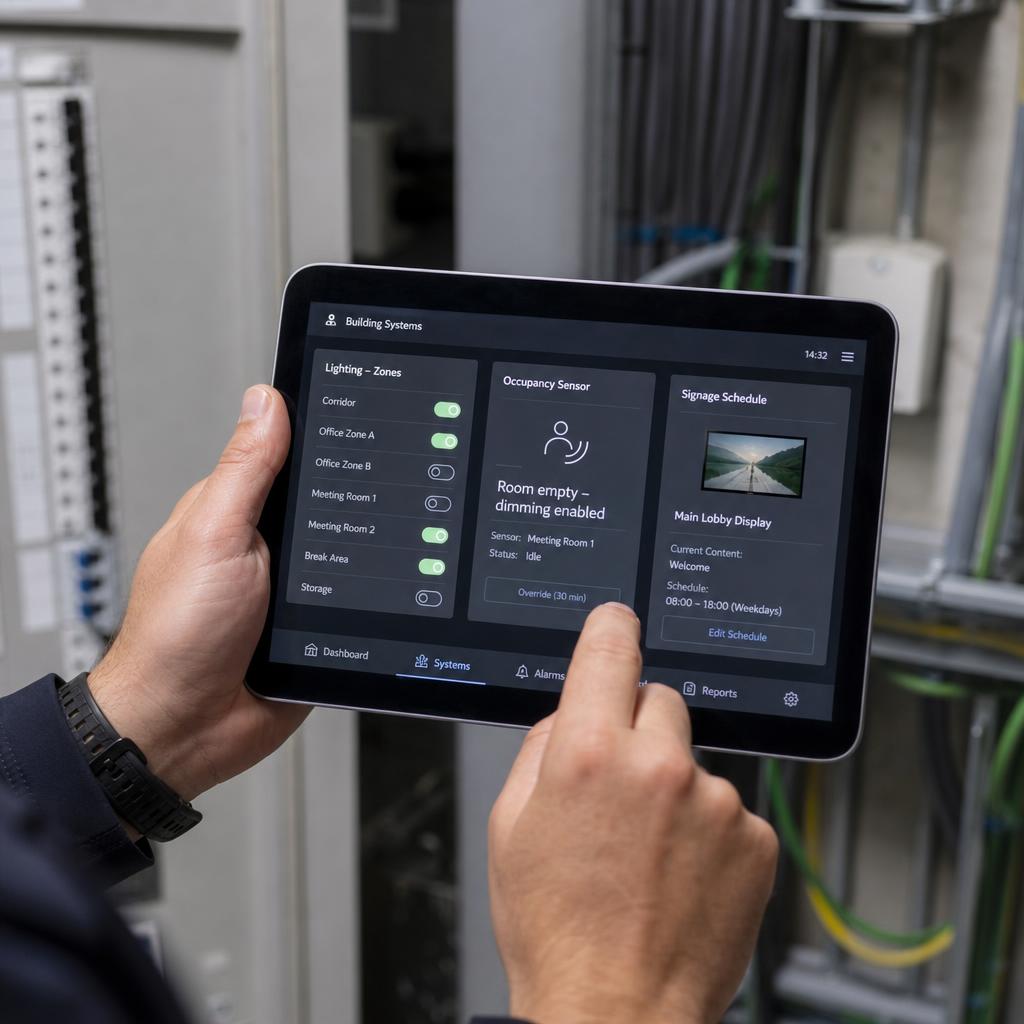
3. Signage Converges With IoT and Environment Control
Three or four years ago the screen and the building sat on separate systems: a signage CMS for content, a building management system for lighting and climate, a separate sensor network for occupancy. None of them talking.
That is converging. Operators expect to manage lighting zones, HVAC scheduling and occupancy sensors from the same dashboard where they schedule content — because running five disconnected tools was never the goal, it was the only option.
This is deep enough to be its own category rather than a bullet under "signage features". For protocols, sensor types and what is realistic versus vendor marketing, IoT environment control covers it properly.
There is a practical energy angle, separate from any efficiency claim. A screen that dims or powers down when occupancy reads empty, or syncs brightness to a connected lighting zone instead of running a fixed backlight all day, is a small but real reduction in the running cost of a large fleet. Facilities teams now ask for this as a matter of course.
4. Remote Fleet Management Is No Longer a Premium Tier
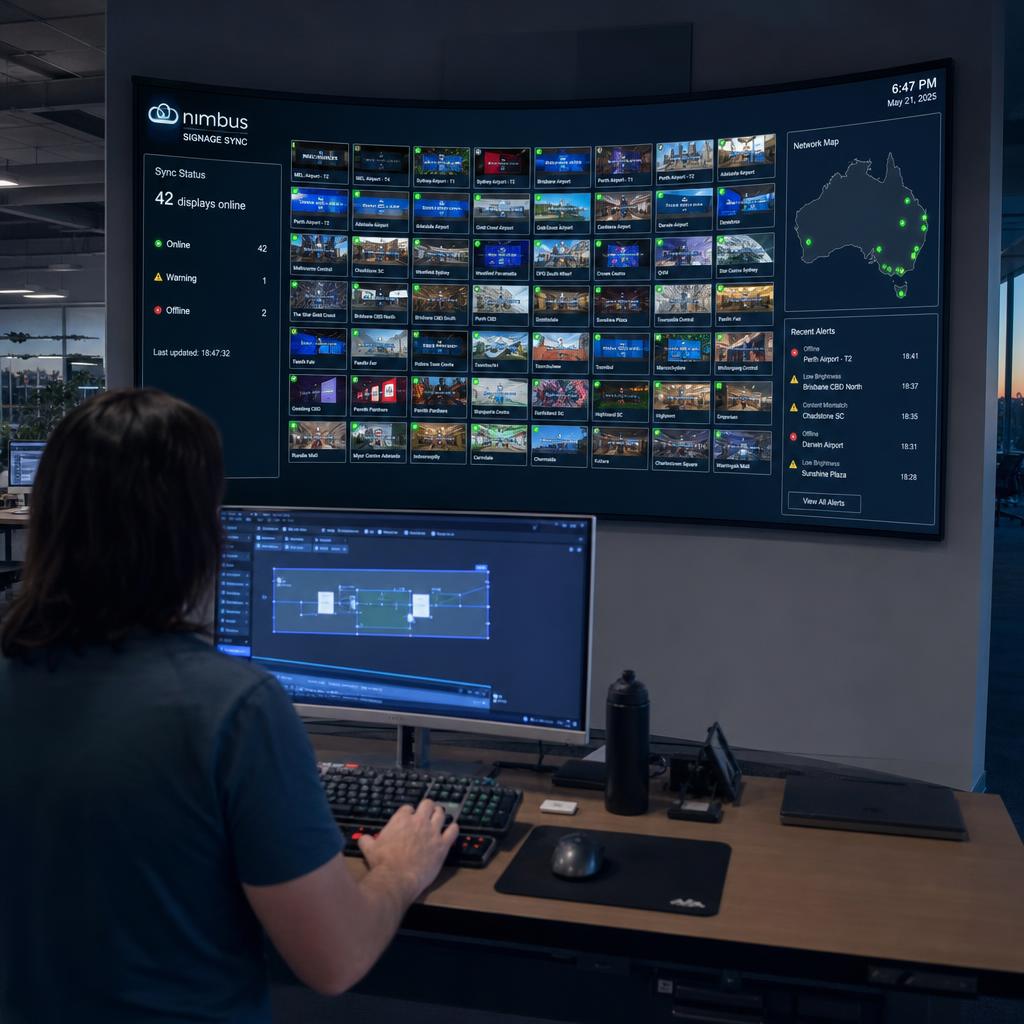
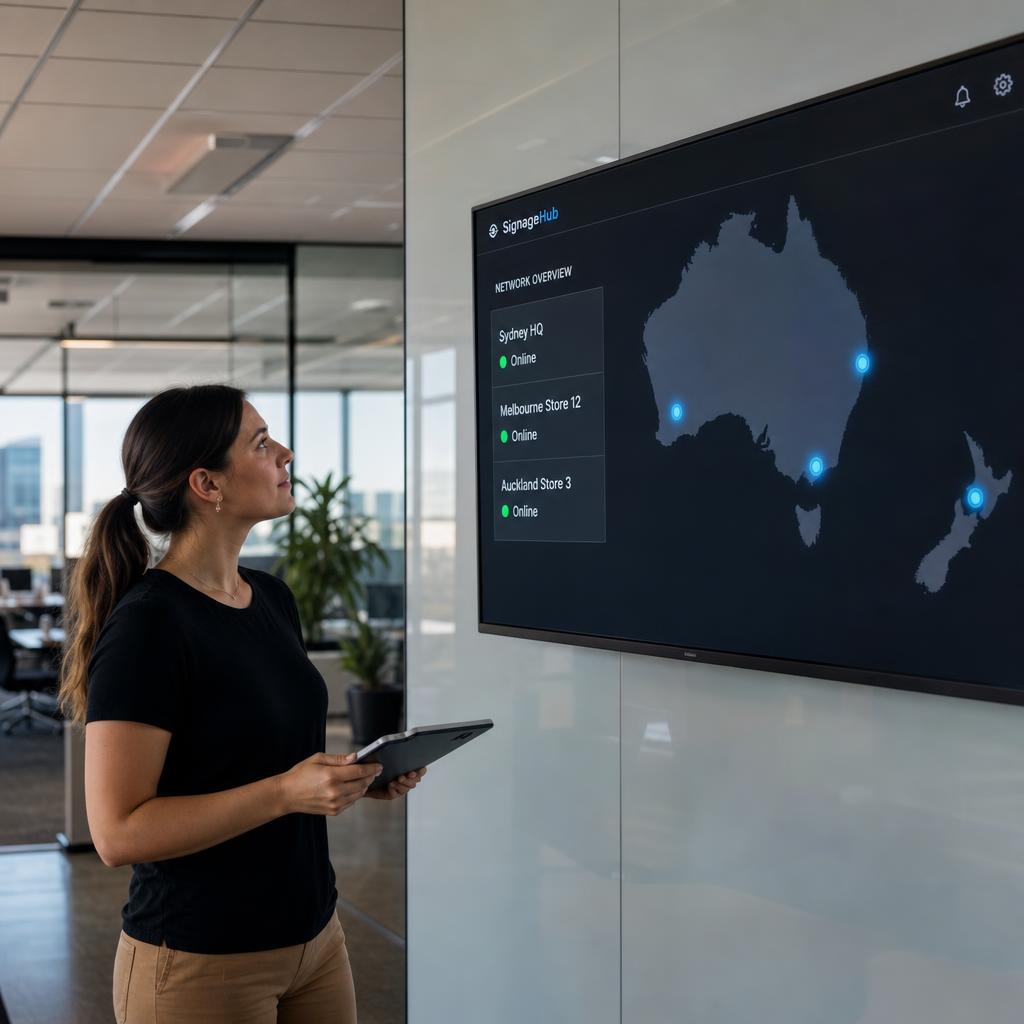
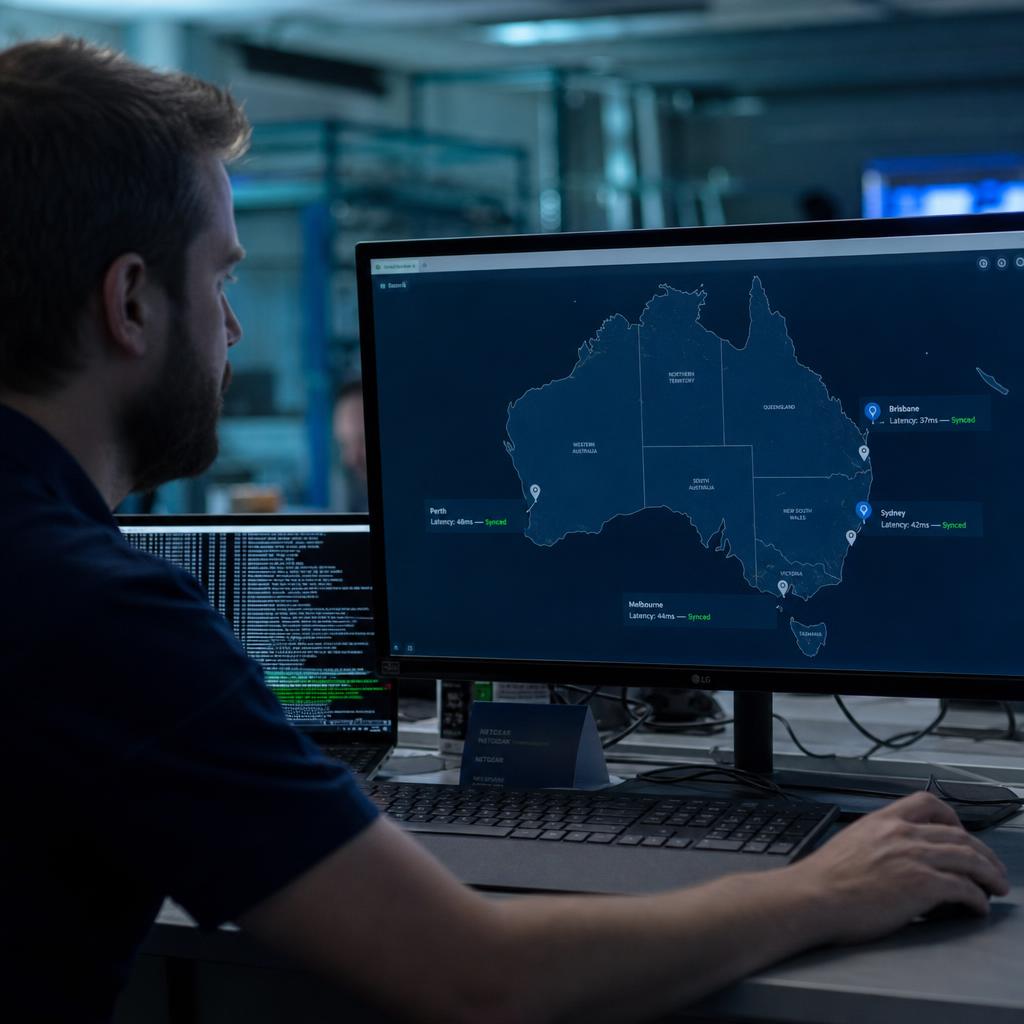
Five years ago, remote reboot, health monitoring and offline caching bumped you to the Enterprise column. Today a platform that cannot tell you which screens are offline right now, without a site visit, is behind the market.
Now baseline rather than differentiator:
- Fleet health monitoring
- Scheduled overnight deployments
- Automatic failover to cached content when connectivity drops
This matters most for AV integrators managing screens across dozens of client sites, where one truck roll for a black screen eats the margin on the contract.
The gap between "remote management as a checkbox" and "remote management that actually reduces site visits" becomes expensive quickly at scale. We have covered what remote screen control software has to do to genuinely cut support overhead rather than demo well.
Australian fleets add a wrinkle most overseas platform reviews skip: regional and remote sites with patchy connectivity. Offline caching that keeps a screen playing through a dropout, and queues deployment changes to sync when connectivity returns, is the difference between a platform that works nationally and one that works in a capital city with reliable fibre.
5. Proof-of-Play Becomes a Buying Requirement
For a long time "the content played" was taken on faith. A playlist was scheduled, an operator assumed it ran, reporting stopped there.
That changes as more screens carry paid or co-op content, where a brand partner paying for placement wants evidence rather than an assumption.
Proof-of-play logs — screen ID, timestamp, loop instance, actual duration played — are now a standard reporting expectation, not a special export.
The practical test when evaluating a platform: ask for a proof-of-play report broken down by screen and campaign. If it is a built-in export, good. If it is a custom job someone has to build, the platform has not caught up with where buyers moved.
This is most visible in retail media networks, where a store's screens are sold as advertising inventory alongside the retailer's own promotions. That model only works if the retailer can hand a brand partner a report showing exactly when and where their content ran. A spreadsheet of assumptions does not survive a media audit.
6. Media Player Hardware Gets Simpler
The hardware side is converging too.
- System-on-chip displays with the player built into the panel reduce how often a separate box is necessary — one fewer point of failure, one fewer thing to mount, cable and replace
- LED video wall control is moving from standalone processor software on a separate PC to native control inside the platform that schedules content, so an operator is not switching between a signage dashboard and a Novastar or Colorlight utility to manage one wall
For AV integrators this is directly commercial: fewer boxes to stock, fewer support calls that turn out to be a driver conflict between two pieces of software, and a cleaner story about what the client is actually buying.
What These Trends Mean When You're Evaluating a Platform
| Trend | Where it stood a few years ago | What's standard today |
|---|---|---|
| Audience analytics | Optional add-on, separate camera hardware and dashboard | Built into the platform; anonymised counts and dwell time as default reporting |
| Content targeting | Fixed schedules by day-part | Rules-based triggers on occupancy, weather, inventory and calendar data |
| Environment control | Separate building management system, no integration | Lighting, climate and sensors managed from the same dashboard as screens |
| Fleet management | Paid add-on or enterprise-only tier | Expected baseline, even on mid-tier plans |
| Performance reporting | Anecdotal — "the content played" assumed | Exportable proof-of-play logs tied to campaign and screen ID |
Five questions cut through vendor marketing quickly:
- Does audience analytics run on-device, or require uploading footage to a third party?
- Can a non-technical operator configure a content trigger, or does every rule need a developer and a ticket?
- Is fleet health visible in real time, or only after someone reports a black screen at a site you cannot see?
- Does the platform export proof-of-play as a standard report, or build it on request?
- Does content keep playing through a connectivity drop, or does the screen go dark until the network returns?
These are not hypothetical. They are exactly where deployments break down once a fleet grows past a handful of screens, which is a large part of why so many implementations stall short of what was promised in the sales process. The architecture side of that is covered in why digital signage fails at scale.
If you are running that comparison now, book a demo and put all five questions to us directly — on-device analytics, a trigger configured live, fleet health on your own screens, a proof-of-play export, and a player deliberately taken offline.
Frequently asked questions
What is the biggest digital signage trend right now?
The clearest shift is AI-driven audience analytics moving from an optional, expensive add-on to a default reporting feature built into the base platform. Anonymised audience counts and dwell-time data are increasingly treated as standard output rather than a premium upsell.
Do I need special cameras to get audience analytics from digital signage?
Not with current platforms. Audience counting and dwell-time measurement typically run on the same edge hardware already driving the screen, using aggregate, anonymised data rather than facial recognition or stored footage. Check that any platform you evaluate processes this on-device and doesn't retain raw video.
What does "environment-aware content" actually mean in practice?
It means content changes in response to real triggers — occupancy sensors, weather data, inventory levels, time and calendar feeds — via a rules engine, rather than a marketer manually swapping a playlist. It's not generative content design; it's conditional logic acting on live data.
Is remote fleet management included in most digital signage platforms today?
It's increasingly expected as standard rather than sold as a premium tier. Real-time screen health monitoring, remote reboot and offline content caching have shifted from enterprise-only extras to baseline features, particularly important for AV integrators managing multi-site client fleets.
How is proof-of-play different from just assuming content played?
Proof-of-play is a logged record — screen ID, timestamp, loop instance and actual duration — that confirms content ran, rather than an assumption based on a schedule being set. It's becoming a standard reporting requirement wherever paid or co-op content is involved, since brand partners increasingly want evidence, not a status update.
Will I need to replace my hardware to take advantage of these trends?
Not necessarily. Most of these shifts live in the software and platform layer rather than requiring new screens. The exception is very old media players with limited processing headroom for on-device analytics — in that case, a hardware refresh may be worth budgeting for alongside a platform change.
What should I actually check when comparing digital signage platforms in 2026?
Ask for a live proof-of-play export, ask whether content rules can be configured without developer involvement, and ask to see fleet health monitoring in real time rather than in a screenshot. Those three checks expose the gap between marketing copy and what a platform actually does at scale faster than any feature list.