Event digital signage sponsorship works when a venue treats its screens as inventory, not decoration. That means three things:
- Rotation — sponsor content scheduled into a fair, rule-based rotation
- Tiers — packages that differ by placement and exclusivity, not price alone
- Reporting — proof of what ran, and when
Venues that skip this structure share the same three symptoms:
- Under-delivering on sponsor commitments
- Chasing screenshots as proof of play
- Struggling to justify the renewal conversation
This guide covers how to build the tiers, schedule rotations that hold up under contract, and produce the reporting sponsors expect before they sign again.
Why Should Screens Be Part of the Sponsorship Deal?
Static banners have a fixed cost and a fixed return. Once printed, a sponsor's logo occupies the same spot for the life of the event — regardless of foot traffic, session times or audience mix.
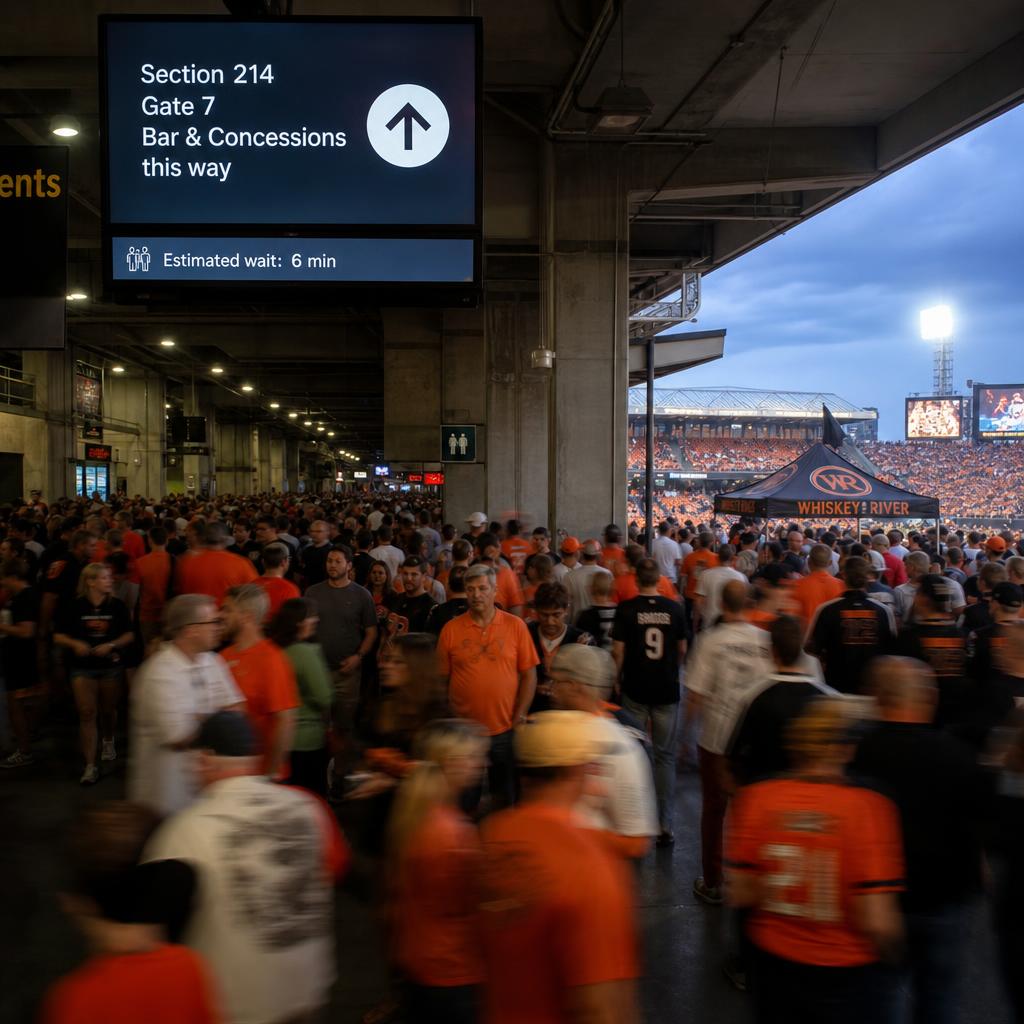
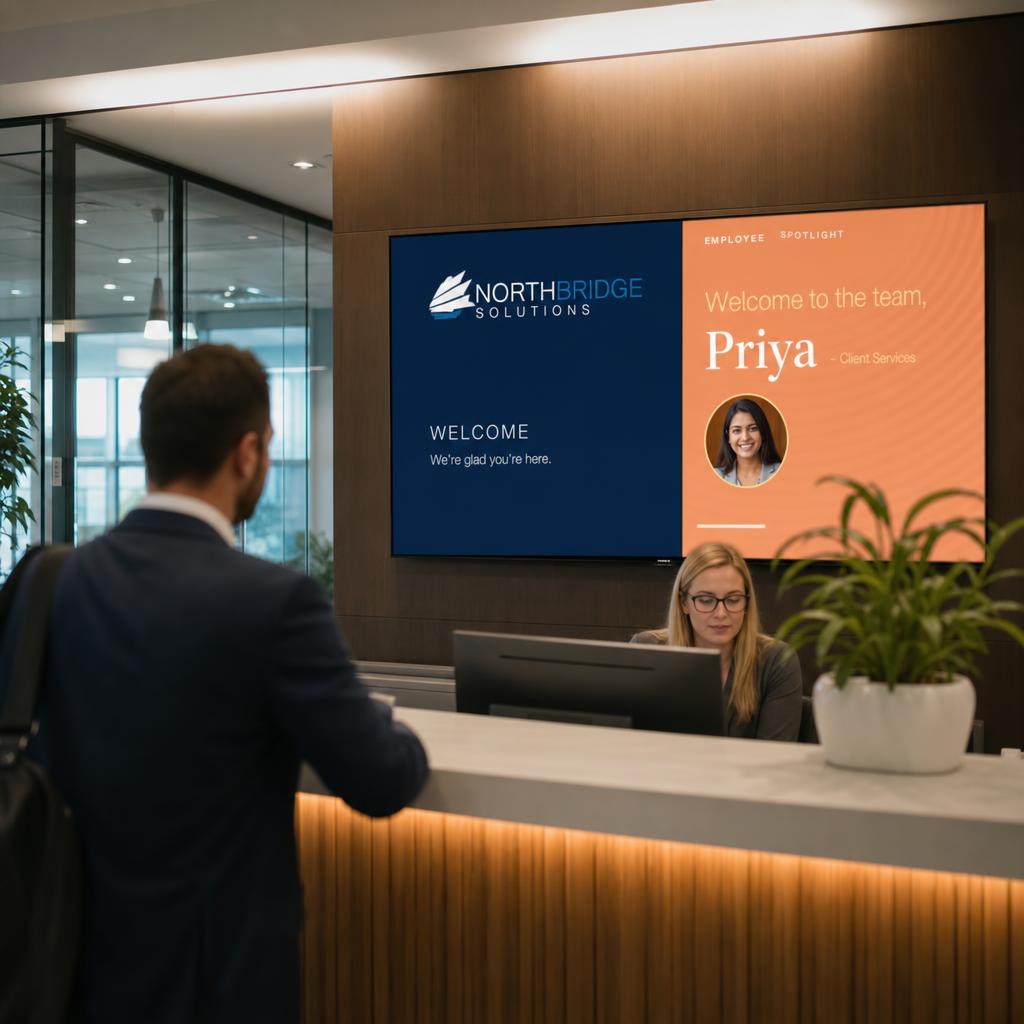
Digital signage changes the equation. The same screen can carry:
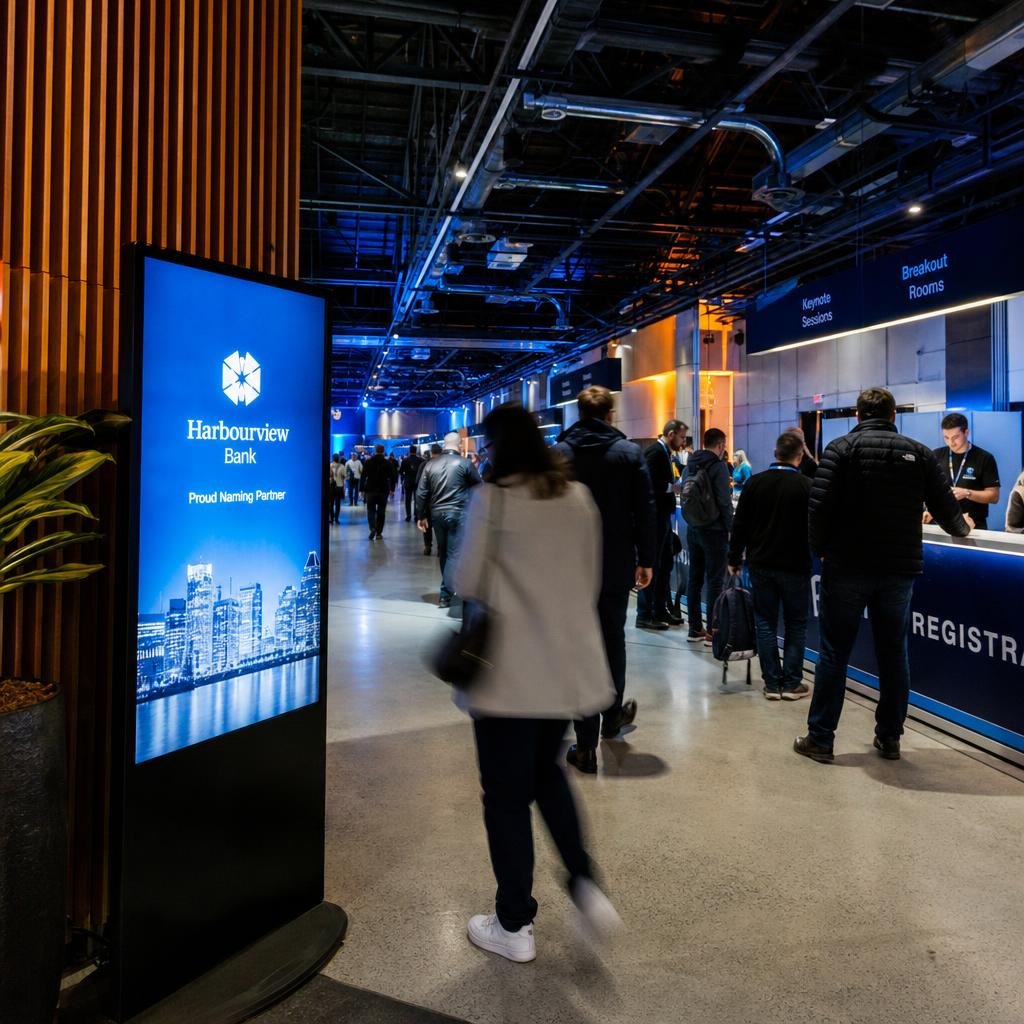
- A naming-rights sponsor during a keynote
- A secondary sponsor during a break
- A wayfinding message between sessions
All without reprinting anything.
For operators this is the difference between screens as a sunk cost and screens as a channel that can be sold, contracted and renewed.
That only holds if the operational side is built properly. A sponsor who pays for exposure and cannot verify they received it will not renew, no matter how good the screens looked on site.
The mechanics matter more than the technology:
- How tiers are defined
- How rotation is scheduled
- How proof of play is reported back
This is also where sponsorship differs from general venue signage management. Managing a fleet of screens is a separate operational discipline, covered in our guide to enterprise display management.
Sponsorship monetisation sits on top of that foundation. It is the commercial layer deciding who gets airtime, how often, and what they are shown as proof.
How Do You Structure Tiered Sponsorship Packages?
The biggest mistake event operators make is pricing sponsorship tiers on screen count alone. A sponsor doesn't just want their logo on a screen - they want to know how often it will appear, whether they're sharing that appearance with competitors, and where in the venue it sits relative to foot traffic.
A workable tier structure differentiates on four variables, not price:
- Placement: which screens the sponsor appears on - main-stage displays, entrance and registration screens, session-room screens, or wayfinding and directory screens.
- Rotation share: how large a slice of the rotation loop the sponsor's content occupies relative to other sponsors and house content.
- Exclusivity: whether the sponsor is the only one in their category (or on a given screen) during defined windows, such as a keynote or a peak-traffic period.
- Reporting depth: what level of proof-of-play detail is included - summary confirmation versus itemised logs by screen and timestamp.
Below is a template structure event operators can adapt. It deliberately avoids dollar figures - pricing depends on venue size, audience and market, and should be set locally rather than copied from a guide.
| Tier | Screen Placement | Rotation Share | Exclusivity | Reporting |
|---|---|---|---|---|
| Naming/Platform | Main stage, entrance, all high-traffic screens | Largest guaranteed share, often first-in-loop | Category exclusive across the event | Full itemised proof-of-play logs |
| Premium | Main stage plus select session rooms | Above-average share, priority positioning | Category exclusive during nominated windows only | Itemised logs plus summary report |
| Standard | Session rooms and general circulation screens | Equal or standard share with other sponsors | Non-exclusive, shared rotation | Summary play-count report |
| Community/Non-profit | Circulation and directory screens only | Reduced share, off-peak rotation | Non-exclusive | Confirmation of placement only |
The value of a table like this is that it forces the sponsorship conversation onto operational terms the venue can actually deliver, rather than vague promises of "exposure."
How Do You Build a Rotation Sponsors Can Trust?
Once tiers are defined, the rotation schedule is what makes the contract enforceable. A rotation schedule is simply the rule set that decides which content plays, on which screen, in which order, and for how long.
Three things need to be true for a rotation schedule to hold up:
It reflects the contracted rotation share. If a premium sponsor is contracted for a larger share of the loop than a standard sponsor, the scheduling system needs to enforce that ratio automatically rather than relying on someone manually reordering a playlist before each session.
It respects exclusivity windows. If a sponsor has paid for category exclusivity during a keynote, the system needs to suppress competing sponsor content on the relevant screens for that window and reinstate the full rotation afterwards - without a staff member needing to remember to do it.
It's consistent across every screen in scope. A sponsor who is told they'll appear on "all main circulation screens" needs that content pushed to every screen in that group at the same cadence, not just the ones closest to the control room.
This is where scheduling tools matter more than screen count.
Manually rebuilding playlists for every session, break and exclusivity window does not scale past a handful of sponsors — and it is the most common point where operators quietly fail to deliver what was sold.
Rule-based scheduling keeps a multi-sponsor event honest without adding headcount on event day. Three rules do most of the work:
- Rotation shares
- Dayparting
- Screen groups, defined once and applied automatically
What Reporting Do Sponsors Actually Ask For?
Sponsors renew based on evidence, not enthusiasm. The single most common request from a sponsorship manager after an event isn't a satisfaction survey - it's proof that the agreed content ran, on the agreed screens, at the agreed frequency.
At minimum, sponsors expect to see:
- Confirmation of placement: which screens their content played on, matched against the screens named in the contract.
- Play count and timing: how many times their content played, and across what time windows - particularly during any exclusivity period they paid for.
- Duration accuracy: whether their content played for its intended length each time, not truncated or skipped.
- A format they can forward internally: sponsorship managers usually need to pass this reporting up to their own stakeholders, so a clean exportable report matters more than a live dashboard only the venue can see.
What does not satisfy this:
- Screenshots and verbal assurance
- A general "impressions" estimate based on foot traffic, which conflates audience size with actual proof of play
What sponsors are really asking for is an audit trail: a record tying specific content to specific screens at specific times, generated by the system rather than reconstructed after the fact by a staff member.
What Does a Platform Need to Run Multiple Sponsors?
Running sponsor content alongside house content and wayfinding on the same screens has a few non-negotiable technical requirements:
- Content scheduling by screen group and daypart, so a naming-rights sponsor's exclusivity window doesn't require touching every individual screen by hand.
- Playlist rules that enforce rotation share, rather than relying on the order content happens to be uploaded in.
- Proof-of-play logging at the device level, so reporting reflects what actually rendered on screen rather than what was scheduled to render - the two aren't always the same if a screen drops offline mid-event.
- Central content approval, so sponsor assets go through a review step before they reach a screen, protecting both the venue and other sponsors sharing the rotation.
- API access, for venues that need to pull sponsor play data into their own CRM or sponsorship management platform rather than working entirely inside the signage dashboard. Details on how that data can move between systems are covered in our piece on digital signage API integrations.
These are not advanced features reserved for large stadiums. A mid-sized conference centre running three or four sponsors across a two-day event needs the same underlying capability, at a smaller scale.
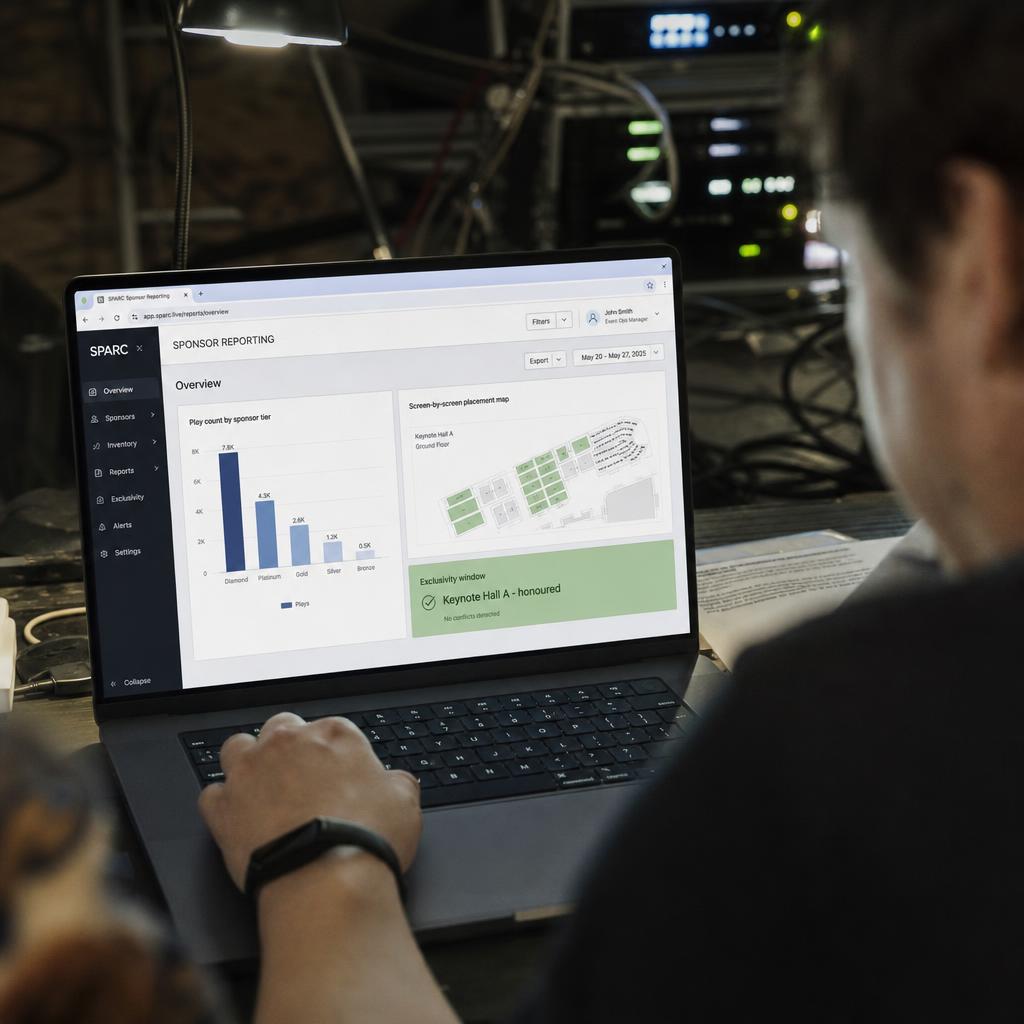
SPARC's content scheduling and reporting features are built around exactly this:
- Screen groups
- Rotation rules
- Per-device proof-of-play
So the reporting a sponsor asks for is generated, not assembled by hand.
How Does Reporting Turn Into a Renewal?
The purpose of proof-of-play reporting isn't just contract compliance - it's the evidence base for the renewal conversation. A sponsorship manager deciding whether to come back next year is weighing what they paid against what they can point to as delivered.
A useful renewal pack pulls together three things:
- The placement and rotation report, showing the contract was honoured in full
- Any exclusivity windows, confirmed as delivered
- A plain description of where the sponsor's content sat relative to other tiers — useful when pitching an upgrade for the next event
None of this requires inventing engagement or ROI figures. It is an accurate account of what ran, matched against what was promised.
Where operators get this wrong is treating reporting as something generated reactively, only when a sponsor asks. Building it into the standard post-event process - generated automatically once the event closes - means the venue walks into the renewal conversation with evidence already in hand, rather than scrambling to reconstruct a rotation log from memory.
What Undermines Sponsor Trust Most Often?
A few recurring issues show up across event and venue operators trying to monetise screens:
- Selling exclusivity the system can't enforce. If a sponsor is promised category exclusivity but the rotation schedule doesn't actually suppress competing content, this only surfaces when the sponsor notices - usually too late to fix before the event ends.
- Treating all screens as equal inventory. A screen at the main entrance and a screen outside a breakout room don't carry the same value, and pricing them identically undersells the good inventory and overpromises the weak inventory.
- No fallback for offline screens. If a screen drops off the network during a sponsor's exclusivity window, that's a delivery failure the venue needs to know about immediately, not discover when the sponsor asks why their play count looks low.
- Reporting that can't be traced to a specific screen and time. A total play count across "all screens" isn't useful when a sponsor wants to know their keynote-window exclusivity was actually honoured on the main stage screen specifically.
- No renewal pack ready at event close. Waiting for the sponsor to request proof of performance puts the venue on the back foot in a conversation it should be leading.
Most of these come down to the same root cause: treating sponsorship as a sales exercise that ends once the contract is signed, rather than an operational commitment that needs to be scheduled, monitored and reported on like any other part of the event.
Sponsorship only becomes a genuine revenue channel when the mechanics hold up under a contract, not just in a sales deck — tiering, rotation, reporting.
Venues that get this right turn sponsorship into a repeatable line item rather than a one-off favour to a partner.
Book a demo to see the scheduling and reporting tools running against your own venue's screens.
Event digital signage FAQs
What is event digital signage sponsorship?
It's the practice of selling advertising space on a venue's digital screens to sponsors, structured as tiered packages that differ by screen placement, rotation share and exclusivity, with reporting that proves the sponsor's content ran as contracted.
How many sponsorship tiers should a venue offer?
Most venues manage well with three to four tiers - enough to differentiate premium placement from standard rotation without making the structure too complex to schedule or explain to sponsors. A naming-rights or platform tier, a premium tier, a standard tier and a community or non-profit tier is a common starting structure.
What proof-of-play reporting should sponsors expect?
At minimum, confirmation of which screens their content played on, how many times it played, the time windows it appeared in, and whether it played for its full intended duration. Sponsors managing exclusivity deals will also want this broken down by screen and timestamp rather than as a single aggregate figure.
Does sponsorship signage require different hardware to standard venue signage?
No. The differentiator is the software layer - scheduling rules, screen groups, exclusivity windows and proof-of-play logging - rather than the display hardware itself. Existing screens used for wayfinding or general messaging can typically be brought into a sponsorship rotation without a hardware upgrade.
How does sponsor reporting support renewal conversations?
It gives the venue an evidence-based starting point rather than a subjective pitch. A report showing exactly what ran, when, and against which tier lets the venue demonstrate the contract was honoured in full and make a factual case for renewal or an upgrade to a higher tier.