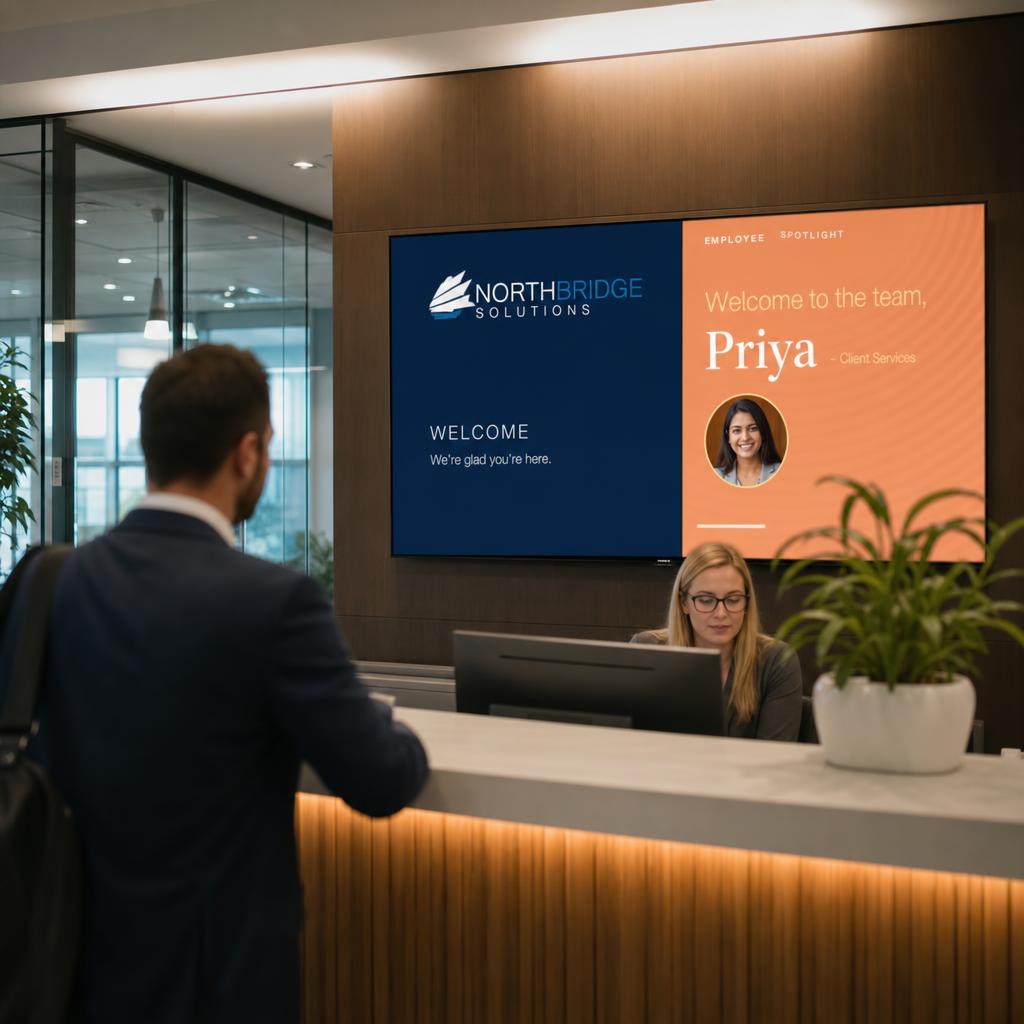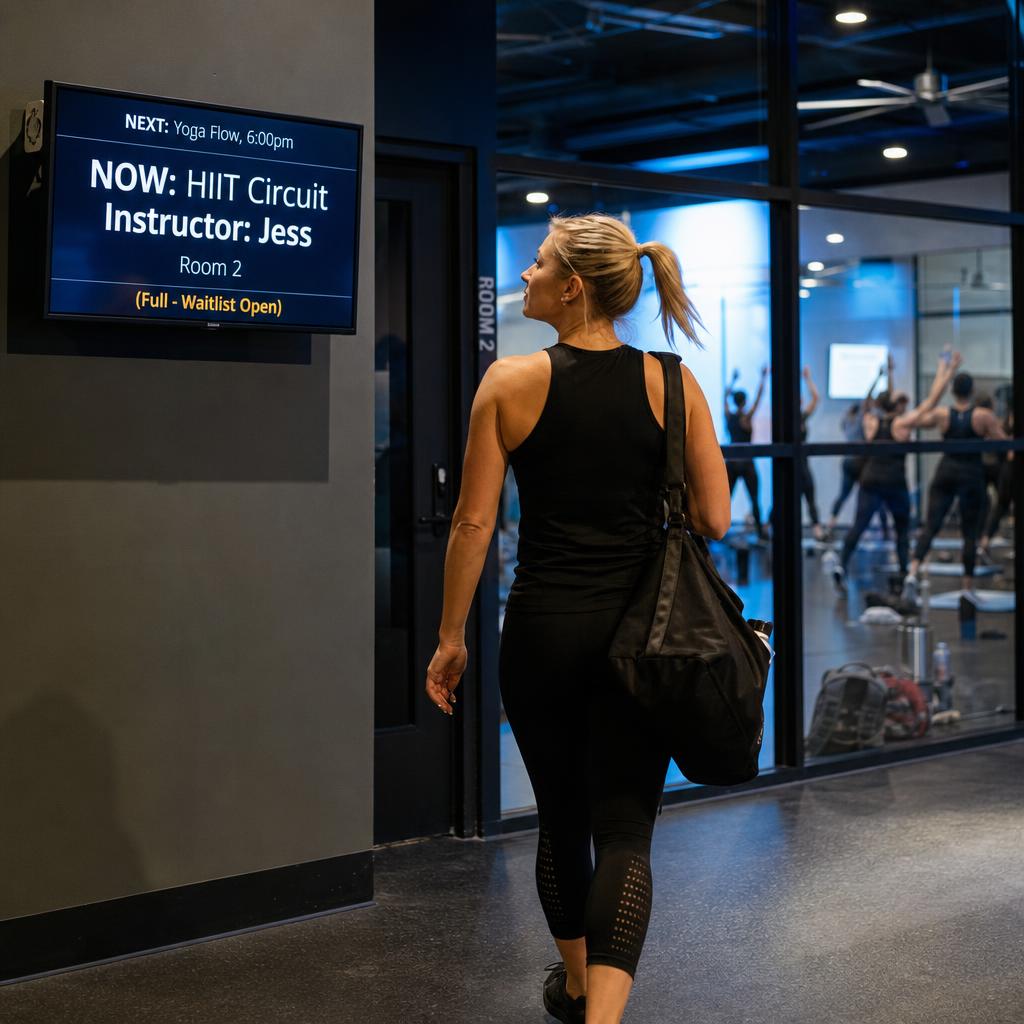
A member walks up to the group fitness studio, checks the screen by the door, and it says the 6pm Reps class is on.
It isn't. The instructor called in sick an hour ago and the front desk cancelled it in the booking system. The member waits outside a locked studio for ten minutes before giving up.
That single moment does more damage to a club's credibility than almost anything else on the wall. Digital signage for fitness clubs only earns its keep when it reflects what is actually happening on the floor, in real time, without a staff member editing a slide.
Most signage content written for gyms is generic retail signage with the word "fitness" swapped in. It ignores the two things that make a club genuinely different:
- Schedules that change hour to hour, not once a season
- A membership base walking past the same screens three to five times a week, who will tune them out fast
Why Fitness Clubs Need a Different Approach to Digital Signage
A retail store's signage problem is attention: get a shopper to notice a promotion once, on the way past.
A fitness club's problem is trust and repetition. The same member sees your reception screen every Monday, Wednesday and Friday at 6:15am for two years. If it is wrong once, they stop trusting it. If it is static, they stop looking.
That changes the brief. Fitness signage has to solve three problems generic retail signage does not:
- Time-sensitivity — class times, instructor changes, cancellations and studio capacity change through the day
- Frequency fatigue — regulars see the same screens dozens of times a month, so content needs enough rotation to stay worth a glance
- Multi-zone relevance — someone in the group fitness corridor needs different information to someone on the gym floor, often at the same moment
Solving those three is the actual job. The hardware, the player and the CMS are all in service of getting them right.
Class Schedules and Studio Status
The most common failure point in gym signage is the gap between what is booked in the club's management platform and what is on screen.
If a schedule change means logging into a CMS and editing a slide, that update eventually gets missed. A staff member is busy on the floor, it is a public holiday roster, or the change happens five minutes before class.
The fix is not better staff discipline. It is removing the manual step by pulling schedule and status data from the source system — Mindbody, Glofox, Perfect Gym, TeamUp or an in-house platform — so the screen outside the studio matches what the member sees in the app.
That means:
- Class name, time, instructor and studio populate automatically, not from a spreadsheet someone retypes weekly
- Cancellations and substitutions push through immediately, not at the next content refresh
- "Class full" or "waitlist open" is visible before a member queues at the door
- Studio-door screens show what is on now and next, so nobody guesses whether they are in the wrong room
This part of fitness signage has nothing to do with design polish and everything to do with data plumbing. A beautifully designed schedule board that is wrong is worse than a plain one that is right.
For the technical detail on how a live feed gets built, our piece on digital signage API integrations covers how screens connect to booking and membership systems rather than relying on manual entry.
Content by Club Zone
Not every screen should show the same loop. A member scanning in at reception needs different information to someone resting between sets.
Treating every screen as one generic playlist is the most common way gym signage becomes wallpaper.
| Club zone | Primary content | Update frequency | Risk if generic |
|---|---|---|---|
| Reception / entry | Today's class schedule, studio status, welcome messages, safety/facility notices | Real-time (booking system feed) | Members miss cancellations, front desk fields avoidable questions |
| Group fitness studio corridor | Current and next class, instructor, capacity/waitlist status | Real-time | Members wait outside cancelled or relocated classes |
| Gym floor | Motivational content, challenge leaderboards, PT availability, safety reminders | Daily/weekly rotation | Screens become ignored background noise |
| Cafe / juice bar / lounge | Menu boards, member offers, community news, event promotion | Daily/weekly, with dayparting (breakfast vs post-work) | Members don't associate the space with anything beyond a TV playing sport |
| Locker rooms / corridors | Wayfinding, facility notices, class starting-soon reminders | As needed | Missed classes, confusion for new or visiting members |
Zoning is not complexity for its own sake. A schedule board bolted to the cafe wall is as useless as a menu board on the studio door.
Keeping Member Screens From Becoming Wallpaper
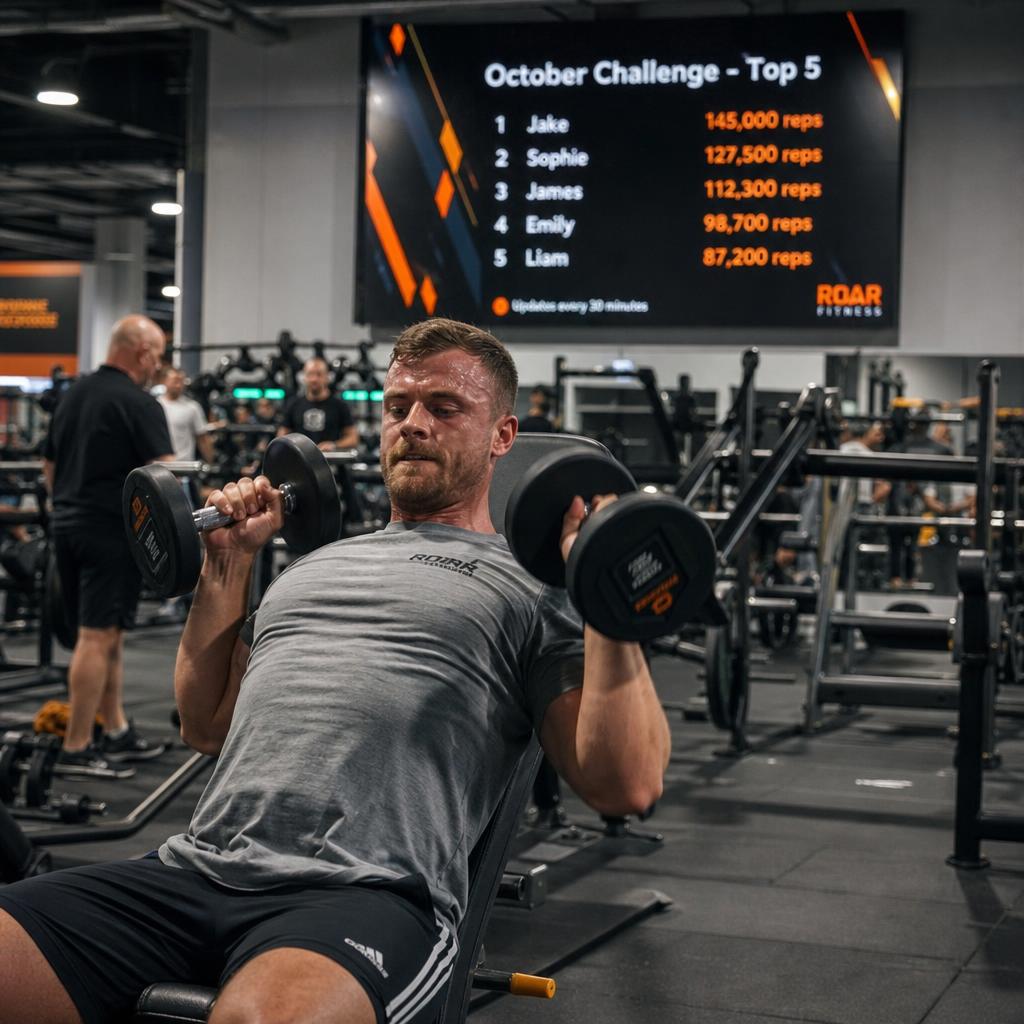
Community content — challenge leaderboards, member achievements, transformation milestones, upcoming events — works in a gym in a way it would not in retail. The audience is a community that returns constantly and wants to see itself on the walls.
But it has a shelf life. A leaderboard unchanged in three weeks, or a "member of the month" slide showing last quarter's winner, tells members nobody is paying attention to the screens either.
Four guardrails keep it working:
- Rotate on a schedule someone owns. A named person refreshes it weekly, not "whenever marketing gets to it"
- Mix formats, not just messages. Static congratulation slides get skipped faster than a short clip, a live leaderboard or a poll prompt
- Keep the ratio sane. At 80% promotional offers, members read the screens as advertising and stop reading them
- Let local clubs contribute, even inside a locked template — a shout-out from a specific instructor reads as authentic in a way head-office content never does
The goal is not maximum content volume. It is that when a member looks up, something on screen is new since they last checked.
Multi-Location Brand Consistency Without Losing Local Personality
For a chain or franchise operator, two legitimate needs pull against each other. Head office wants consistent branding, messaging and compliance content. Each club wants to celebrate its own instructors, community wins and local promotions.
Signage that only serves head office feels corporate and disconnected from the floor. Signage where every club does its own thing is inconsistent and unmanageable at scale.
The practical answer is a layered content model:
- Locked national layer — brand assets, safety and compliance notices, national promotions, core templates, controlled centrally and pushed everywhere
- Regional layer — content relevant to a state or region, such as seasonal campaigns
- Local layer — an on-brand template each club populates itself: this week's challenge winner, a new instructor bio, a public holiday timetable change
This only works if local staff can update their layer without design skills or IT support, and without touching the locked brand layer. Centralised management with scoped local permissions is what makes a 40-site chain deployable without a bottleneck at head office or brand chaos on the floor.
The same underlying challenge is covered in more depth in enterprise display management.
Integrating With Booking and Membership Platforms
Everything above depends on the signage system talking to the platforms a club already runs on.
Manual content entry does not just risk errors. It is the reason schedule content quietly stops being updated a few months after rollout, once it becomes one more admin task.
Look for signage that can pull from:
- Class booking and scheduling platforms (Mindbody, Glofox, TeamUp, Perfect Gym, or bespoke systems) for live class, instructor and capacity data
- Membership management systems for welcome messaging, tier promotions or renewal reminders
- Point-of-sale or cafe ordering systems for menu boards that update with stock and seasonal changes
- Calendar or events platforms for one-off classes, workshops and community events
Ask the integration question early in any vendor evaluation. It is the difference between signage that stays accurate on its own and signage that degrades into stale manual slides within a term.
Wayfinding and the Member Journey
Beyond schedules and motivation, gym signage has a practical job: helping members and visitors navigate a facility that is not always intuitive.
Directional screens near entries, corridor junctions and locker rooms — pointing to studios, the gym floor, cafe, change rooms and PT consultation rooms — do two things:
- Reduce "where's the spin studio?" questions at the front desk
- Make a stronger first impression on trial members and visitors from other sites
This matters more for chains than it sounds. A member who trains at their home club but visits a sister site should be able to orient themselves from the signage alone, without relying on staff who do not recognise them.
Getting a Multi-Site Rollout Right
A single-club rollout is a content and hardware project. A multi-site chain rollout is a change-management project that happens to involve screens.
The clubs that get sustained value plan for:
- A content governance model — who owns national, regional and local layers — before hardware goes on the wall
- A realistic maintenance plan, because screens and players need uptime monitoring, not just content
- Staff training at each site, so local content stays fresh without depending on head office
- A phased rollout — pilot site, review, then scale — so booking system integration issues get caught early
Putting Gym Digital Signage in Front of Your Members
SPARC is built and hosted in Australia — Melbourne-built, with AWS infrastructure in Sydney — which matters for chains wanting local support and data handling rather than an offshore platform.
If your class schedules still get retyped by hand, that is the place to start. Book a demo and we will connect it to your booking system and show the studio-door screen updating itself, or read how this applies to clubs on our fitness industry page.
Frequently asked questions
Do we need different signage software for each club, or can we manage a whole chain from one system?
A well-built multi-site deployment runs from a single centralised platform with local permissions, not separate systems per club. This lets head office push brand-locked content everywhere while individual clubs manage a defined local content layer — schedule updates, local promotions, community shout-outs — without needing separate software or IT support at each site.
How do we stop class schedule screens from showing outdated or cancelled classes?
The screen needs to pull directly from the same booking system staff and members use to book classes, rather than being updated manually. When a class is cancelled or an instructor changes in the booking platform, that change should flow through to the screen automatically, ideally within minutes.
Will digital signage actually get used, or will members just tune it out like they do with most gym TVs?
It depends almost entirely on relevance and rotation. Screens showing accurate, zone-relevant content — the class that's actually on next, not a stale promotional loop — get checked regularly. Screens running the same generic content week after week get ignored, regardless of how good the hardware is.
Can local club staff add their own content without messing up the brand?
Yes, with the right setup. A layered content model locks core brand assets and compliance content centrally while giving local staff a defined, on-brand template — like a photo-and-caption slot for a challenge winner — that they can update themselves without design tools or approval bottlenecks.
What happens if a screen goes offline or a player fails at one of our clubs?
This should be visible from a central dashboard rather than discovered when a member complains or a staff member notices a blank screen. Look for signage platforms with remote monitoring and alerting across every site, so faults get flagged and resolved before they affect the member experience.
Do we need separate screens for schedules versus motivational or promotional content?
Not necessarily separate hardware, but definitely separate content logic by zone. A studio-door screen should prioritise real-time class and capacity status; a gym-floor screen can carry more motivational and community content since there's no time-critical information at stake there. The zoning matters more than the number of screens.
How long does a typical multi-site rollout take?
It varies by chain size and how complex the existing booking and membership integrations are, but a phased approach — pilot at one site, resolve integration issues, then roll out to the rest of the network — is generally more reliable than a simultaneous chain-wide launch, since it surfaces data feed problems before they affect every club at once.